StatCounter

http://statcounter.com/p4130240/summary/?guest=1

Monday, June 11, 2012

‘The greatest fear is the fear of death’


Religious and secular motivational speakers talk about their experiences 

Photos: Swami Sandeepananda Giri and Fr. Augustine Valooran

By Shevlin Sebastian  

In a television studio, at Thiruvananthapuram, Swami Sandeepananda Giri, preacher of the Bhagwad Gita, sits cross-legged in front of two mikes. Behind him is an image of Lord Krishna riding a chariot.

He says, “There has never been a time when you and I have not existed, nor will there be a time when we will cease to exist. The human being inhabits the body through the stages of childhood, youth, and old age, but at the time of death, he will go into another body.” The bearded Sandeepananda is wearing a saffron shirt and speaks in a simple language using expressive hand gestures.

Ever since he debuted on the Doordarshan channel on April 14, 2006, Sandeepananda has been a popular speaker on the Bhagwad Gita. So far, more than 2000 programmes have been aired. He has also travelled to Europe, USA, Australia, Canada, and has been a speaker at the Convocation of Hindu Spiritual Leaders at the 2009 Parliament of World Religions in Melbourne. “The doubts and problems that Arjuna faced in his life is present in every person's life in the 21st century,” he says.  

Sandeepananda has interacted with all types of people. So what is it that troubles the average person? “The strongest fear is the fear of death,” he says. “But there are many other anxieties. When elections take place, there is an apprehension of losing among the political parties. When a woman is pregnant, she is worried. A girl sits for her examination, and she is scared. When a youngster is about to get married, he is terrified. All this happens because of the intense attachment to life and things.”

Man has a spirit, which connects him to God’

Fr. Augustine Valooran is the director of the hugely popular Divine Retreat Centre, at Muringoor, about 42 kms from Kochi. A veteran speaker of over 25 years, he says, “My main message is that man should lead an honourable life on earth. He should be transcendent. Man is a body, but at the same time there is a spirit in him, which connects him to God.”

Apart from Muringoor, he has preached all over the world. “The biggest problem in people is selfishness,” he says. “And this brings about excessive consumerism, immorality, and greed.”

Asked about the qualities of being a good public speaker, Fr. Valooran says, “You should have a message.
And that is to challenge individuals to lead a greater life than what he or she is leading now. Secondly, do not look down on anyone. Whoever came to Jesus Christ, He never condemned them. Finally, you must make the audience feel important. And the truth is that each and every person is important in this world.” 


Follow the tenets in the Quran’

Since Kunju Mohammed Pulavath, a lecturer in Kochi, is fluent in Arabic, he is invited to give talks on the Quran. “The Quran provides solutions for all of life’s problems,” he says. “I talk about the relevance of the Holy Book.”

Pulavath says that people suffer from all kinds of problems: financial, social, mental, and spiritual. “The only way out is to have a deep belief in God,” says Pulavath. “The first and last resort is always Prophet Mohammad. If you want peace of mind and a good life, always follow the tenets as propagated in the Quran.”

To be an effective speaker, it is important to know the profile of an audience. “If the audience is a highly-educated one, you can give an intellectual speech with a lot of scholarship in it,” he says. “When the audience comprises ordinary people, I use simple language. I don’t shout or yell. I tell a lot of stories. I always keep my speeches short and to the point.” 

Every thought has an electrical impulse’

After securing his MBA, Sajeev Nair began his career in corporate planning and marketing and spent several years working for blue-chip companies. But in 1998, he moved to the direct-selling industry. “All types of people join this industry,” he says. “They need to be brought up to a certain level. Training has to be given on how to be a good entrepreneur, how to dress and talk and develop the right attitude. I wanted to transform people’s lives.” For several years, he worked with Amway and now he is involved with Mona Vie, the fastest growing direct-selling company in the world.

Sajeev’s theory on transformation is simple. “The way a person thinks determines many outcomes in his life,” he says. “Every thought has an electrical impulse. The neurons are communicating through a neurotransmitter. When you have the same thought over and over again, the same bunch of neurons is firing. Soon, a strong neural pathway is formed. So, it is difficult to change your habits and attitudes, which are usually negative.”

He bemoans the fact that in Kerala, there is an atmosphere of negativity. “It has been built up over a period of time,” says Sajeev. “That perspective has to change. People should have an attitude of appreciation and encouragement.” 

'Delete negative files in the mind’

Dr. P.P. Vijayan is standing among a group of eager listeners at a conference hall at a five-star hotel in Kochi. “People behave badly because of the memory of negative events lodged in the subconscious mind,” he tells the audience. “It is necessary to delete these files. Patanjali says the mind is like a fog. That is because of emotions like anger and resentment.”  

The group is a mix of entrepreneurs, professionals, housewives and students. Vijayan, wearing a black suit and trousers, has been a motivational speaker for 25 years.

Vijayan continues in the same mode. “You have to understand the language of the subconscious mind — the images and the emotions behind it. First, something is created in the mind, then in reality. For example: the Burj Al Khalifa, the tallest building in the world, was first conceived in a person's mind. If the image created is perfect, then the resources will come, along with the right financier and architect.”

Vijayan speaks in a measured tone and yet there is something compelling about his speech. “You have to understand your audience, only then can you be effective,” he says. “If we are able to give solutions to their pain, they will be happy.”

However, to enjoy this happiness the price is a bit stiff: the cost for each participant for a one-day programme is Rs 4900. 

(The New Indian Express, south India and Delhi) 

Saturday, June 09, 2012

Split Wide Open

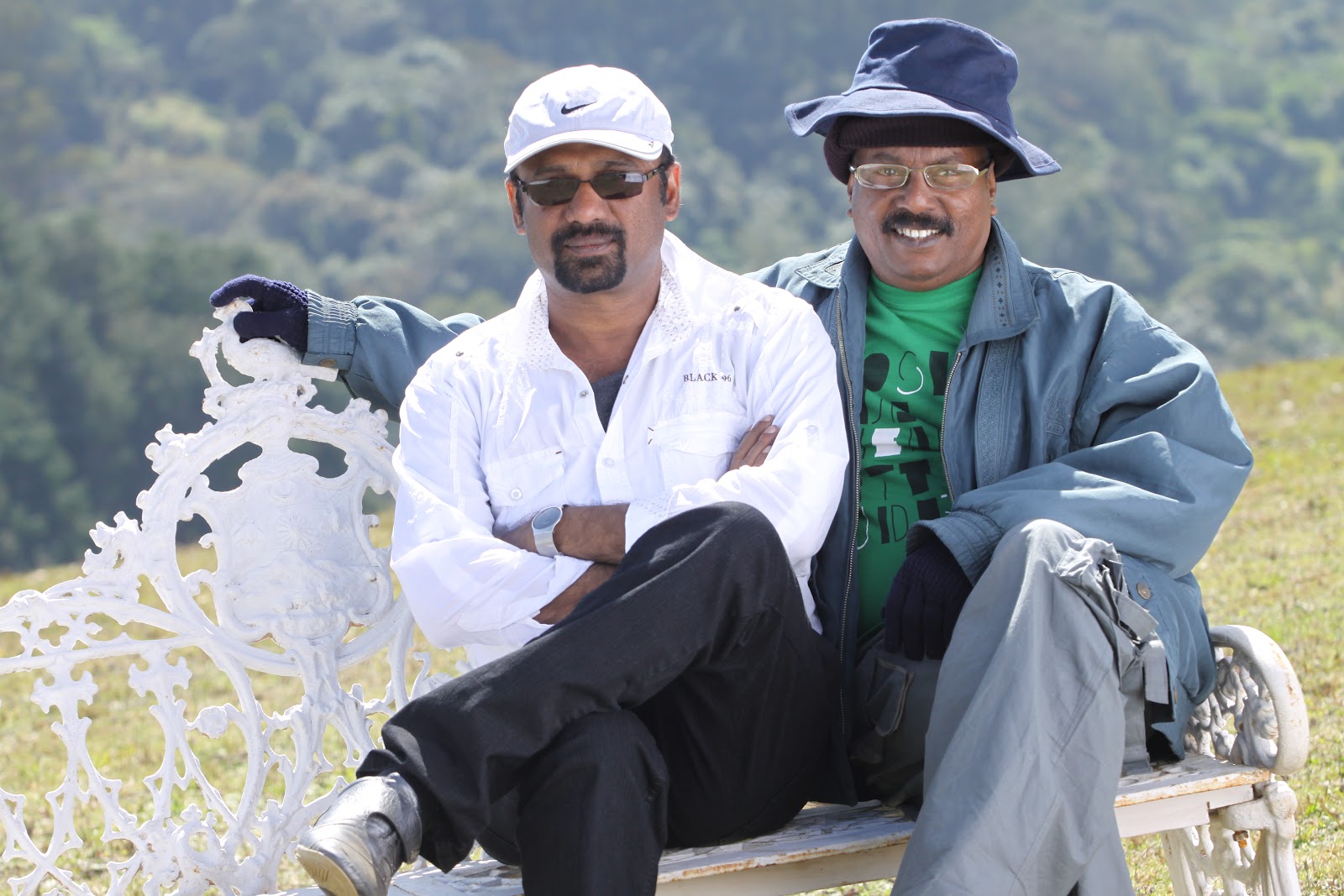
Because of the desire to move in a new creative direction, the successful partnership of Rafi-Mecartin, the director duo, is coming to an end

Photo: Rafi and Mecartin

By Shevlin Sebastian

At 11 p.m. on November 11, 2007, Mecartin experienced an uneasiness within himself. He felt cold and began shivering. Mecartin was at Ottapallam for the shooting of the film, ‘Romeo’. “I had a sixth sense that something was wrong,” says Mecartin. “I feared that I would slide into unconsciousness.”

He called many people but all were sleeping. Finally, he got Rafi who quickly came to his room. Thereafter, Mecartin was rushed to a private hospital in Ottapallam. There, Mecartin had a stroke of luck. Sometime earlier, another patient had a heart attack. Medicines had been specifically bought to treat the victim. Some of the medicines were not used. “The doctor present, Shanmugham, used it on me,” says Mecartin. “That helped me to survive my attack.”

But during this period, when Mecartin had become unconscious, he had a strange experience. He was in a place where it was all white. “I could feel the tears flowing down my face,” says Mecartin. “I also experienced a joy that I have never felt before.”

A few hours later, when Mecartin opened his eyes, he saw the doctor and nurses and felt a deep disappointment. “I did not want to come back,” he says. “I was happy where I was. But from that moment on, I wanted to begin a new chapter in my life.”

Mecartin believes in the concept of rebirths, even while a person is living his life. “Till 20, I was a student,” he says. “Then I became a keyboard player, studying Carnatic music. Then I got interested in drama. I took part in many plays. Thereafter, I became an employee. Following that, I moved to mimicry. I met up with Rafi and that went on for a few years. Then both of us went into films. Around 25 years went like this.”

But today, Mecartin wants to go in a different direction in his film career. “People expect a Rafi-Mecartin film to be a melodrama, quarrels between family members, and slapstick comedy,” he says.

He gives an example of slapstick comedy. “In a Siddique Lal film, one character will say, ‘Govinda Kutty is going through nice times,’” he says. “The next scene will be of Govindakutty hanging from a rope. That is slapstick comedy, but it is not realism.”

Mecartin says he enjoys making these movies. “But now, I want to make serious films. Yes, I am aware that I have to make the movie in such a way that the producer does not lose money, and the audience should also like it. But Rafi is not keen to do such films.”

The director-duo has been together for 17 years and made about 23 films, the majority of them hits and superhits. These include ‘Puthukottyile Puthu Manavalan, ‘Superman’, ‘Punjabi House, ‘Thenkasipattanam, ‘Chathikkatha Chanthu, ‘Pandippada, and ‘Hallo.

So, one morning, Mecartin invited Rafi over to his apartment near the JN International Stadium at Kaloor, and they discussed the matter for one whole day. In the end, Rafi accepted Mecartin’s decision. However, initial media reports indicated that they split over a quarrel.

“There was nothing like that,” says Mecartin. “It was a mutually amicable parting.” 

Rafi also agrees. “I accepted his decision,” he says. “Mecartin wants to make a different type of film, which is fine with me. Maybe, after a while, we will get together again. It is not a permanent split.”

As for Rafi's plans, he says that he will make films on his own.

But at this moment, both of them are at working on 'Mumbai Dosth', for which they are penning the script. “I think by December, we will be finished with this film,” says Mecartin. “Thereafter, we will go our separate ways.”

(The New Indian Express, All Kerala) 

Friday, June 08, 2012

'Stadia' sports bar opens at the Holiday Inn

By Shevlin Sebastian

Photo by Manu R. Mavelil

The first sports bar in Kochi has opened. This is the 'Stadia' at the Holiday Inn. “We got a very positive response during the IPL [Indian Premier League]” says Raju Shrestha, the general manager. “People in Kochi are passionate about sport. We are looking at the Gen Y crowd who earn handsome salaries these days. Kochi has no place where you can watch sports telecasts and enjoy a drink.”

The hotel is also targeting another segment. “There are people, who, after a hard day's work, would like to unwind by watching sports,” says Nilay Saran, the director of sales. “Many of them bring their families along.”

The 'Stadia' has several paintings on the walls: of gymnasts, basketball players, boxers, pole vaulters and gymnasts, apart from images from previous Olympic Games. On one wall are two long canoes hung up, complete with paddles and seats. At another side, there are two green baize tables where you can play billiards or snooker. Two youngsters, with large pitchers of beer next to them, are enjoying a mid-afternoon game.

On each table, there is a small statue of a golfer taking a swing. And not to forgot big television screens mounted up on the walls above tables. There is also a proper bar, where you can sit on stools and have a drink. To reinforce the sporting angle, there is a large bronze statue of a muscular basketball player, with ball in hand, placed on the fluorescent counter-top.

Spread over an area of 2500 sq. ft. the bar caters to about 100 people at a time. It is open from 11 a.m. to midnight.

For those who want to watch sports in an air-conditioned ambiance, along with good snacks and drinks, 'Stadia' is the place to be. 

(The New Indian Express, Kochi)

Thursday, June 07, 2012

All that jazz!


Mishko M'Ba and his band played superbly at a concert to honour of one of jazz music's greatest artists -- the late Jaco Pastorius 

Photos: Mishko M'Ba (extreme left) with his band; the late Jaco Pastorius 

By Shevlin Sebastian

When Mishko M'Ba steps on the stage, the audience is taken aback. He has thick brown braids going all the way down, from his head, almost to the floor. The braids are brown, while the curly hair on his head is grey. The pencil-thin Mishko wears a striped black and white coat, but one side is longer than the other. Underneath is a black T-shirt. Apart from that, he has long narrow trousers, and grey shoes.

The other band members look more regular: saxophonist Matt Littlewood, in jeans and white shirt, but with a tiny tuft under his lips. Drummer Suresh Bascara wears a white T-shirt that looks more like a vest. And Karan Joseph is an ordinary guy excepts when he starts to play the keyboard. Then he grimaces, opens his mouth, nods, shakes his head from side to side, as if he is going through excruciating pain.

The group's performance was a 25th anniversary tribute to Jaco Pastorius, who died, in 1987, at the age of 35. Regarded as a legend for his innovations, Pastorius is one of the most influential electric bass players of all time. In 1988, the late musician was inducted in the Jazz Hall of Fame. 

As journalist Bill Milkowski writes in 'Jazz Times': “Today, that unique two-syllable name still registers awe in Japan and France, Germany and Switzerland, Italy and England, Cameroon and Korea, all throughout North America and South America -- and everywhere else that people recognize heart and soul.” As for Mishko he stumbled upon Pastorious’ solo album, ‘Jaco’. “It remained my reference album for several years,” he says. “When its influence was everywhere, I decided not to listen to it any more.” 

Mishko began proceedings with 'Come on, Come over'. It takes a while to learn to enjoy the sounds of jazz. But Mishko easily makes an impression, what with his fingers dancing over the strings, a master at work. He frequently closes his eyes, bends his body with the effort, and communicates constantly through his eyes with the other members. 

The French-born Mishko studied classical music in Toulouse, before concentrating on jazz and rock. He has played with legends like the late 'soul' singer Ray Charles. Today, he is associated with many jazz groups all over the world, and divides his time between Pondicherry and France.

Soon, the band plays jazz great Miles Davis' 'Donna Lee'. In this song, it was interesting to see Suresh hitting the drums with the flat of his palms, as well as on the cymbals. In the '3 View of Secret', the saxophone takes the lead, with gentle accompaniment by the guitar and drums.

Thereafter, the band moves into 'Opus Pocus'. Says reviewer Jared Pauley in jazz.com: 'Jaco Pastorius composed a hypnotic groove for ‘Opus Pocus’, complete with steel drums. The best part is when Pastorius plays a bass line. This is one of the funkiest songs I have ever heard and I would beg anyone to disagree with me.'

But clearly not everybody in the Kochi audience agrees. Mrs. P takes a blissful nap. She awakens briefly when a song ends and there is applause. Thereafter, the eyelids slide shut and it is off to noddy land, while Mishko and his team strain sinew and muscle to keep the audience awake. But this is being unfair to Mishko. There are fans who shout, 'Wah Wah', and seem to be enjoying the show.

Entrepreneur Ajai Joseph says, “It was amazing. They played some wonderful stuff. I have listened to jazz greats like Charlie Parker on CDs, but this was the first concert that I was attending.”

E. Nandakumar, the former CEO of BPCL-Cochin Refinery, also found the concert interesting. “However, I felt, there was not much of a variety, as compared to Indian classical music,” he says. But Nandakumar liked the latter half of the concert, when the group played songs like 'Continuum', 'Birdland', ' Teen Town,' and 'The Chicken'.

‘The Chicken’, which was the finale, even to one who is not attuned to jazz in any way, can be easily recognized as a superb work, creating all sorts of wonderful emotions in the listener. In the end, Mishko and his band impressed with their remarkable skills and talent.

(The New Indian Express, Kochi) 

Wednesday, June 06, 2012

It was hot all the way


A dance programme, ‘Hot Steps’, organised by the Verb School of Dance, delighted a Kochi audience

Photos: Aparna Gopinath (centre) with the Mamas; Vinu John and Virginia Benjamin doing the salsa. 

Pics: Mithun Vinod

By Shevlin Sebastian 

The Chennai-based Verb School of Dance came to do two days of salsa classes. Encouraged by the response, they did a summer coaching camp for children as well as elders. Six weeks later, with their students, they did a show called ‘Hot Steps’, on Saturday, at the Fine Arts Hall, Kochi.

And what an event it was. It began when dancers in brown jackets with hoods, stood around holding a sheet. Underneath were other dancers who were writhing and shaking their bodies. The music was pulsating, with a thumping beat. The dancers picked flags and swayed from side to side. Sometimes, they broke into a break dance.

The age range was remarkable: from five-year-olds to middle-aged mamas. When the children performed, it was to lyrics like ‘Oh Girl you are mine, I wanna be with you.’ At the end of the dance, the climax was a wink by the youngsters to the audience, which looked sweet and endearing.

Each dance sparkled, because of the vibrant music, mixed by DJ Savio and stunning costumes. Sometimes, it was black pants, shirts, and shoes, with glittering jackets. At other times, it was blue sleeveless tops and silver trousers. Or it was white and red tracksuits, or orange trousers. One group wore a yellow T-shirt with the inscription, ‘Give Your Fat The Boot’. During their dance, a couple of the boys leapt from the stage and landed just inches before the front row.  

And all types of dances were performed: Western Contemporary, Disco, Broadway, Bollywood, Hip-Hop, Jive, Jewish country folk and Salsa. In total, there were 35 dancers.

Definitely, the highlight was the salsa by Verb founder-director Vinu John and his colleague Virginia Benjamin. Vinu, looking lithe and muscular, in a tight black shirt and trousers, was electrifying with his quick-silver moves, broad grin, and positive energy. Virginia was a good match and their dance movements were mesmerising, to say the least. During one segment, Vinu picked up the leg of Virginia, and strummed her calf like guitar strings.

The Kochi connection was set off by the Jewish folk song, ‘Hava Nageela’. Girls sat on the floor, wearing red pinafores, and swung yellow ribbons at the end of sticks. The haunting folk song had a soothing effect.

And the mamas, not to be outdone, rocked to the ‘Chikni Chameli’ song from the film ‘Agneepath’. They wore skirts and blouses, with alternating blue and red panels. The women were having a blast, shaking their bodies, moving back and forth, and taking deep breaths through open mouths.

Aparna Gopinath, Vinu’s wife, caught the eye, with her sheer energy and joy. It seemed that dance had enabled her to shed inhibitions, which had suffocated her for years, and she expressed a sense of freedom that women rarely enjoy in India. “Dance is my passion,” says Aparna, who is also an actor, director, and choreographer. “I love being on stage.”

Audience member Padmini Krishnan says, “The show was beautifully choreographed. Many of them had never danced before, but still they put a good show. Their energy was contagious.”

Thanks also to lively compering by Anjali Uthup Kurian, it was a fun way to spend an evening.

(The New Indian Express, Kochi and Thiruvananthapuram)

Tuesday, June 05, 2012

“Sudheesh is simple and sweet”


COLUMN: Spouse's Turn

Dhanya talks about her actor-husband

Photo: Dhanya, with Sudeesh and son Rudraksh

By Shevlin Sebastian

Dhanya was 15 years old when she saw actor Sudheesh for the first time in 1995 during a wedding reception for a relative in Kadalundi, near Kozhikode. “I saw him speaking to others and got the feeling he had the ego and pride of a film star,” she says. “He did not pay any attention to me.”

But Dhanya did not mind. She was just excited that she had seen a film star at close quarters. “I only wanted to tell my friends about it,” she says.

A few years later, her colleague at the Calicut School of Fine Arts, Arun, a distant relative of Sudheesh, told the star's parents about Dhanya. “At the same time, a relative of my mother approached Sudheesh's family with my proposal,” says Dhanya. “She said that if Arun's choice does not work out, she could suggest another girl, not knowing that it was me in both cases.”

Eventually, Sudheesh met her officially at Dhanya's mother's home at Kurumboyil. Both liked each other. Says Dhanya: “Sudheesh looked like an innocent and sweet boy.”

They got married on March 30, 2005. And what she likes most about Sudheesh is his relaxed attitude towards his career. “Sudheesh is happy with whatever roles that he gets,” says Dhanya. “He does not get tensed up if he is not getting more opportunities.”

However, it seems that the public is tense. “Whenever we go out, people will come up and tell Sudheesh, 'You act so well, why can't you be the hero?' My husband is never affected by this. He is not ambitious. So, it is easy to live with him. He spends a lot of time with us [The couple has a six-year-old son, Rudraksh]. I am happy about this trait.”

The family goes for holidays, as and when they get the chance. But one vacation nearly went wrong. “We had gone for a trip to Ooty,” says Dhanya. There was Sudheesh, Dhanya, her brother Dileep and Rudrakash.

They were returning on their Honda City car through a dense forest in Wayanad at night. A notice board announced that there were wild animals and travellers should be careful.

“But we did not see any animals,” says Dhanya. “We felt that the notice was put up to fool people.” But suddenly, on the road, they saw an elephant, with a raised trunk. Unwittingly, Sudheesh sped towards the elephant, instead of braking. “It looked angry and came charging at us,” says Dhanya. “Somehow, Sudheesh swerved the car and we managed to go past. That was a close escape for all of us.”

The couple is close, but every now and then, Sudheesh gets angry with Dhanya. And the reason is simple. “If some youngsters come to the house to sell things, even though it may not be useful for me, I have a tendency to buy, just to encourage them,” says the Kozhikode-based Dhanya. “I just take the money from his purse. And he gets upset and says, 'Why do you buy things which you don't need? You are emptying my pocket!'”

When Dhanya reads about financial appeals for help in the newspaper she wants to immediately send the money, but Sudheesh prefers to check out whether the recipients are genuine or not. “I am impatient,” she says. “Sudheesh gets angry about that.”

Although Sudheesh has acted in numerous films in his 25-year career, he is still best known for his role as 'Chanthu' in the 1993 film, ' Manichitrathazhu'. “There is not a single day when we go out and somebody does not call him by Chanthu's nickname, 'Kindi',” says Dhanya.

In fact, recently, they had gone to a restaurant. There was a young woman, who had a child on her lap. She pointed at Sudheesh and said, “Molle [Daughter], look at Uncle. You can call him Kindi.”

(The New Indian Express, Kochi and Thiruvananthapuram) 

Friday, June 01, 2012

An Indian version of the Bible


Artist Edwin Parmar has done a 470-feet long painting depicting scenes from the Bible in an unusual manner

By Shevlin Sebastian 

Photos: Adam and Eve; the crossing of the Red Sea


One day in 2005, Edwin Parmar got an idea. He wanted to do a large painting on Biblical themes. At that time, he was living in Kalol, 40 kms from Ahmedabad. So he bought a thick roll of canvas. “I would open a certain section, do a painting, roll it up, and open the next section,” he says.

In the end the painting was 470 feet long and three feet wide. Edwin worked for 16 hours daily and was able to complete the work in 40 days. This work is now on display at the Pastoral Orientation Centre at Palarivattom, Kochi, at an exhibition organised by the Bible Commission of the Kerala Catholic Bishops' Council.

It is an oil on canvas, and the 101 paintings, each seamlessly moving into the next, immediately grabs the eye, for its simplicity and clean lines. And what immediately becomes clear is that the paintings are different from the usual works on Biblical themes.

So Adam sports black hair, while Eve has waist-length black curls. During the crossing of the Red Sea by the Israelites, the prophet Moses has a black beard. Some of the men wear turbans, while the women have veils. There are a couple of bullocks pulling a cart. When Moses holds up the tablet containing the Ten Commandments, it is written in Hindi.

In another painting the three wise men – who had come to see Jesus at a stable in Bethlehem, just after He was born – look like Indian kings wearing crowns. When the 12-year-old Jesus goes to the temple, in Jerusalem, the scholars whom he meets are wearing round beads, around their neck, just like Hindu priests.

“I wanted to Indianise the paintings,” says Edwin. And he has a particular reason for this. In his village, Kalol, as well as in Mandvi in the Rann of Kutch , where he lived for a few years, the local people are not easily accepting of Christians. “We are not allowed to have our own churches,” says Edwin. “So I wanted to do a painting which shows that our religion is just as Indian as any other faith.”

Meanwhile, in Kochi, all sorts of people have come to see the exhibition: from schoolchildren to elderly people. In the comments book, visitor Lobo Lawrence says, “This is a great inspiration. It takes us through the birth, death, and resurrection of Jesus.” Adds Jayson Jacob:  “It should be exhibited in all the churches.”

So far, the painting has been shown in 39 churches in Thrissur. Fr. Paul Kattukaran, the coordinator of the Artists’ Forum of the Office for Social Communications for the Catholic Bishops' Conference of India, has been helping Edwin in staging the exhibitions.

“The response has been very good,” says Fr. Paul. “But there have been a few people who are upset that the traditional blonde look of Jesus Christ and the people have been changed. Some said, ‘Jews in Israel don’t look like this.’”

But Fr. Paul takes heart that most people like the Indianised version. Incidentally, when the painting is folded up, it weighs 250 kgs.

As for Edwin, following the success of the exhibition in the past two years in Kerala, he has decided to settle down in the state. “For an artist, Kerala is an ideal place. There is peace and greenery and the people are nice,” says Edwin, who is married to Maneesha, a fashion designer. The couple have a three-year-old daughter.   

(The New Indian Express, Kochi and Thiruvananthapuram)

Wednesday, May 30, 2012

A heightened sense of sensibility


Sudarshan Shetty, one of India's leading artists in installation art, talks about the likely impact of the Kochi Biennale, while on a brief visit to the city

Photo: Sudarshan Shetty showing an exhibit in Milan

By Shevlin Sebastian

One evening at Fort Kochi, recently, Sudarshan Shetty, one of India’s premier artists in installation art, was spending time with painters Bose Krishnamachari and Jyoti Basu. As they were talking about how Kochi could become a match for the world-famous Venice Biennale, a large, international ship sailed past.

“It was such a picturesque scene,” says Shetty. “It seemed like a preamble to a Biennale. There was this movement of  people from abroad. Definitely, the Biennale will establish Kochi on the world stage.”

Shetty had come to Kochi to check out the various locations for the Biennale. So, he did go to the Muziris site in Kondungaloor, and all over Kochi. “The trip was fantastic, in terms of understanding the cosmopolitan nature of the city,” he says. “There is such a lot of history, what with all the cultures coming in – Christianity in the first century AD, the Arabian traders from the Middle East, followed by the Portuguese, Dutch, and the British.”

When he went to Jew Town, he felt he was being transported back to another world. “I had the same feeling when I went to Malayatoor, the place where St. Thomas arrived on his visit to Kerala in AD 52, and to the first Muslim mosque in India: the Cheraman Juma Masjid in Kodungaloor.”

Kochi is the most appropriate place for the Biennale. “If you look at the history, it was a place where liberalism was celebrated,” says Shetty. “Everybody was welcomed with open arms. The rulers allowed outsiders to do trade and there were cultural exchanges.”

Asked whether a major city like Mumbai or Delhi would have been appropriate, Shetty says, “In big cities, old buildings have been demolished, in the name of development. As a result, a lot of the history has been erased. But in Kochi, history is an ongoing reality.”

Shetty has been mulling over the type of installation art that he could make, which would be ideal for the setting. “I have been doing a lot of research,” he says. And in the course of it, Shetty has discovered something new.

“In Mangalore, I have been looking at old houses,” says the Mumbai-based Shetty, who belongs to the land-owning Bunt community in Karnataka. “Apparently, a lot of them were designed by Kerala craftsmen. That was very interesting for me. I will be taking ideas from our traditional architecture, and applying it to my own art. I am also going to look at local materials in Kochi.”

During his visit Shetty had a look at the refurbished Durbar Hall art gallery. “It is of an international class,” says Shetty, who has exhibited in London, New York, Milan, Oslo, Davos, Denmark, Japan and the Netherlands. “It has been remade beautifully, and the essential character of the building has been retained. I will give my right hand to exhibit there one day.”

The artist is aware of the controversies regarding the setting up of the Biennale, but says that he knows the people behind the project, Bose Krishnamachari and Riyaz Komu, for more than twenty years. “They are able people and have achieved a lot in their own fields,” says Shetty. “They have a lot of international exposure and the expertise to set up a biennale. Both of them belong to Kerala and that is an added advantage.”

What is also an advantage is the impact it will have on the people. “These initiatives will change the sensibility of the people,” says Shetty.  “Kochi will become an art centre. In Baroda, just because an art school exists, there is a completely different way of viewing art among the ordinary people. In many middle-class homes I have seen paintings by well-known artists. A similar change will take place in Kochi once the international art exhibition comes up.”

In the Kochi Biennale, artists of international class will be showcasing their art every two years. “This will improve the standard of the local artists when they are exposed to international art,” says Shetty. “The fact that I could see a lot of world class art when I was young made a big difference to my artistic sensibility. I could understand how things were made and the processes behind it. The same will happen to the artists in Kochi.” 

(The New Indian Express, Kochi) 

Tuesday, May 29, 2012

In tune with each other


COLUMN: Spouse's Turn 

Dr. V. Krishnan Mohan talks about life with singer Sujatha

Photo: Sujatha, with daughter Shwetha and husband Dr. V. Krishnan Mohan 

By Shevlin Sebastian

Dr. V. Krishna Mohan remembers clearly the first time that he saw Sujatha. It was the year 1971. A wedding was taking place at Guruvayur. Yesudas was scheduled to give a performance. He had invited his friend Mohan to attend it. As Mohan sat on the stage, he saw a seven-year-old girl, wearing a white frock, make her way from the audience towards the platform. Mohan was 19-and-a-half years old at that time.

Soon, Sujatha stood beside Yesudas and sang ‘Mazhavil Kaavadi’ from ‘Nellu’. Thereafter, she sang Lata Mangeshkar's ‘Aaja Re Pardesi’ from the Hindi film, 'Madumati'. “I was struck by her voice,” says Mohan. “She sounded like a professional.” Thereafter, when Sujatha came and sat next to him, after the performance, he leaned sideways, and said, “You have an amazing voice.” Sujatha smiled shyly.

The next day, at the Guruvayur temple, they met accidentally. Sujatha immediately told her mother, “This was the uncle I was sitting next to, on the stage, yesterday.”

Thereafter, the combination of Baby Sujatha and Yesudas created a storm in Kerala. “I saw her in different concerts,” says Mohan. “Soon, through Yesudas, she came to my house in Palakkad. My parents are avid music lovers.”

In 1979, Mohan, an accomplished singer himself, was practising as a doctor at Palakkad. Soon, he began looking out for a life partner. When Chembai Vaidyanatha Bagavathar, the doyen of Carnatic music, whose disciple was Mohan's mother, and Yesudas heard about it, they suggested the name of Sujatha. “Both of them felt that it would be better for Sujatha if she got married into a household which is passionate about music,” says Mohan. “My mother was also very keen. I thought about the pros and cons and finally agreed.”

The marriage took place on May 9, 1981. And Mohan keenly remembers the couple's first overseas trip to America in 1982. At the inaugural concert in New York, Sujatha tripped over certain wires on the stage and dislocated her kneecap. She had to be rushed to the hospital. Thereafter, for the 21-city tour, Sujatha sang from a wheelchair. “Many people thought she was handicapped,” says Mohan.

This incident highlights Sujatha's dedication to music. “She is willing to give her life for a song,” says Mohan. “During a recording session, Sujatha frequently forgets about food and other activities.”

When they go abroad for a concert, Sujatha is not keen to do sightseeing, especially on the day of the performance. “She wants to preserve her voice,” says Mohan. “Sujatha will also not speak much, in order not to strain her throat. So, we maintain 'mauna vratham' (silence). There are many singers who will say, 'Let us go out and enjoy ourselves.' But Sujatha is not like that. This is the attitude of Yesudas and she has been influenced by that.”

And unlike many singers, she does not say 'yes' to each and every concert she is asked to perform. “Sujatha will check everything about the organisers, equipment, stage, audience, and the food,” says Mohan. “If the sponsor is strong and sincere, and will protect her performance, then only will she say yes.”

Sujatha has other qualities that Mohan admires. “She is a good interior decorator,” says Mohan. “By nature, she is methodical and a good mother.”

In fact, Sujatha withdrew from the music scene when she was pregnant with her daughter, Swetha. “She was absent for five years, from 1981-85,” says Mohan. “Many people thought she had retired. We felt she would not be able to make a comeback.”

But Sujatha had a resurgence in her career through Priyadarshan’s film, 'Chitram' in 1988, and composer A.R. Rahman’s Tamil version of 'Roja' in 1991, in which she sang 'Pudhu Vellai Mazhai. It became a big hit and Sujatha has not looked back ever since.

As an artist, she is over-sensitive. “If Sujatha sings a single note wrongly, she gets very upset,” says Mohan. “She will tell me, 'I did not sing well', although nobody else would have noticed the mistake.”

As a result, Mohan is careful in the way he deals with his wife. “I cannot talk roughly with her, the way some husbands do, with their spouses,” he says. “I have to be careful about what I say. I developed a non-interfering attitude. You cannot question her all the time. It was tough initially, but I have learnt to get along with Sujatha. 

Mohan pauses and says, “All this is possible only when there is love. Without love, no marriage can last.”

(The New Indian Express, Kochi and Thiruvananthapuram) 

Monday, May 28, 2012

Out of her brother's shadow


Belinda, the younger sister of Remo Fernandes, sings Spanish, Portuguese, Cuban, Italian, and French songs, with verve and panache

By Shevlin Sebastian

When the curtain goes up for the start of the music concert by Belinda Fernandes and the Tropicanos, the audience is in for a surprise.

Belinda is wearing a purple skirt, with a transparent gold scarf and ghungroos on her feet. And when she begins a Kathak dance, at the JT Performing Arts Centre, Kochi, the music accompaniment is not a tabla and the harmonium, but a fado sung by one of Portugal ’s greatest singers, the late Amalia Rodrigues. There is a nice drum beat, and Belinda twirls around, thumping her feet on the stage, and smiling occasionally.

I was exposed to the fado at home and have a passion for Kathak,” says Belinda. “So I thought, ‘Why not fuse the two?’ It is a dream come true, because nobody had done this earlier.”

The actual performance begins with a Brazilian song. Belinda sings in Spanish, holding an acoustic guitar. In another Brazilian song, ‘Voyeur’ which is about a small bird, despite the title, Belinda plays the flute. And at the end, there is a long duet between Mukesh Ghatwal on keyboards and bass and Munna Chari on timbales and percussion, which reminds one of the legendary jugalbandis between Allah Rakha on the tabla and Ravi Shankar on the sitar.

Belinda has a low-key charisma, made attractive by her evident shyness and introvert nature. When Aaradhana Khanna, the compere, gives a thumbs-up from the second row, Belinda gives a radiant, but relieved smile.

The songs continue: Cuban, Portuguese, Spanish, Italian and French songs. She also sings a song about Goa: of how a most beautiful land is becoming a concrete jungle. Not surprisingly, she also bemoaned the widespread corruption -- an allusion to the land mafia-politician nexus.
   
After the interval, Belinda switches over to a satiny brown top and leggings and wears a bright pink feather hat. She moves easily into the Kizomba, an African-style song from Angola. The group also sings a composition, ‘Chilling out’, which they played for the soon-to-be released film, ‘Love Wrinkle-Free’. And all along, the audience clapped along, unable to resist the sheer magic of the beat.

“It is my first performance in Kochi,” says Belinda. The singer clarifies that they don't do copies of songs. Instead, they are fresh impressions. For 'Voyeur', the band introduced sitar sounds and an alaap.

Incidentally, Belinda is following in the footsteps of her illustrious brother, Remo, who is Goa 's most famous musician. “He has been my idol all along,” says Belinda of her brother, who is eight years older. “I admire his creativity and originality. Remo has formed his own style: a fusion of Indian and Western music.” Sometimes, the Tropicanos performs before Remo in concerts all over the country.

Affected by shyness and stage fright for many years, Belinda turned to academics and secured a doctorate in comparative French literature from the Sorbonne in Paris. Thereafter, she became a professor at Goa University and was also the director of the Alliance Francaise. But her mother’s death in 2005 forced her to go out for parties, with husband Carmelio Machado, to get over the pain.

In Goa, sometimes, bands invite members of the audience to come up and sing. Belinda began to be called up. Suppressing her fear, she sang songs here and there. And that was how she began thinking of a singing career.

In 2006, she set up the band, with her husband as manager, and it has now performed all over the country, in Hongkong and at the ‘Festival of India’ in Macao in 2010. Belinda has also started writing her own songs and has brought out a CD called ‘Belinda - Festa Tropicana’. Here are a couple of lines from the song, 'Unopened Doors': ‘Tiptoeing through your heart/ Should I stay or walk away?’ 

(The New Indian Express, South India and Delhi) 

Crossing over to a new beginning


COLUMN: Spouse's Turn

One of India's premier guitarists, Baiju Dharmajan, is about to release his first solo album, ‘The Crossover’

Photos: Baiju Dharmajan; the cover of the album

By Shevlin Sebastian

A few months ago, Baiju Dharmajan had gone to Munnar to spend a few days. He was accompanied by two members of the music group, 'Kaav': Syam N Pai and Shabeer P Ali. One day, at dawn, Baiju got up and looked out. It was cold, misty, and cloudy. “There was a strange mood,” says Baiju. He picked up the guitar and began to play a few chords. Thankfully, Syam, who had awakened, captured it on a handycam. Syam suggested that that it could be put on the album that Baiju was working on. The latter agreed. “When I returned to Kochi, I developed it into a full-fledged song, called 'Landscape,'” he says.

Thereafter, he worked on another five songs. This comprises the album, 'The Crossover' which is expected to come out at the end of May. “'The Crossover' is the merging of Eastern and Western music,” he says. “Most of the lead guitar sounds have a Carnatic base.”

Among the other compositions there is one called 'Cyber Reptile'. “The new-generation kids are so obsessed with the Internet, Facebook and You Tube, apart from mobile phones,” he says. “They are crawling in cyberspace, like hungry reptiles.”

Another work, 'Philia', is an emotional one. “I wanted to show my love for my daughters,” he says. At present, his elder daughter, Ahana, is in Class 12, while the second child, Neha, is in Class seven. The nearly seven-minute song begins softly and then explodes into some intense lead guitar riffs, backed by drumbeats as background music. There is, as Baiju says, a bit of a Carnatic influence, with the plaintive sound that the guitar makes at times. It is attractive listening.

Since these are instrumental songs, people, who have heard it, have reacted in different ways. “If there were lyrics, there would have been a similar reaction,” says Baiju, with a smile.

What has been unusual is that Baiju played the instruments on his own – the lead and bass guitar  –  and programmed the drums, in his studio, 'Mystic Island', Kochi, and mixed it himself.

But now he has invited a few fellow musicians to play the songs with him. They include Alex Puthumana on the bass, Jayaraj on the drums, and Lancy on vocals and the keyboard. Baiju, of course, will play the lead guitar. In early June, the group will embark on a seven-city tour – Bangalore, Chennai, Mumbai, Ahmedabad, Delhi, Kolkata and Guwahati  – to launch the album. “We are busy doing rehearsals,” he says.

Baiju is releasing the music digitally through international web sites like Amazon and CD Baby. Also, through his recording company, Cochym (old name for Cochin), the CD will be available all over Europe.

The Mumbai-based Heena Kriplani, Entertainment Relations at Gibson Guitar, one of the top guitar brands in the world, has heard the some unmixed tracks from 'The Crossover'. “I love the bits I have heard,” she says. “There is some wonderful instrumentation. It seems to me that Baiju has really come into his own on this solo album.”

It is clear that Baiju has a God-given talent. “But he has backed it up with sheer hard work,” says Heena. “The things that he can do with a guitar are quite remarkable.”


When Baiju quit the well-known Motherjane band on November 24, 2010, people wondered what his future direction was going to be like. But he has been busy, appearing on the Dewarists show on Star World, a collaboration of musicians of different genres.

Baiju played with noted US-based percussionist and composer Karshkale, and Harigovind, a master of the Edakka drum. He was also a producer of 'Kaav's album, ‘Rhapsody of Rain’, and did a tour with the jazz fusion band called Blue Fire. “We played in Mumbai, Pune, and Goa,” he says.

When asked whether he has any regrets about leaving Motherjane, Baiju says, “Not at all. I have been composing new songs, changed my style of play, and worked with different groups. I have associated with all types of musicians. It has been fun and a good time creatively.”

(The New Indian Express, Kochi and Thiruvananthapuram) 

Friday, May 25, 2012

Fear and paranoia


Many people are afflicted with mental diseases like schizophrenia. They are unable to distinguish between fact and delusion. May 24 is World Schizophrenia Day

By Shevlin Sebastian

One morning, Ramesh Menon (name changed), a schizophrenia patient, set out to do a cartoon. But there was nothing funny in it. He drew an agonised man, with open mouth and shut eyes. Inside the head, where the brain is located, there are several questions marks. Just outside, above the temple, there is another series of question marks, ending in a large one near the forehead.

“I view everything suspiciously,” says Ramesh, describing the cartoon. “I told my mother about the disturbances caused by such thoughts. I get peculiar ideas often. At the same time, I believe I am blessed. I have a divine nature within me. But no one believes me.”

In another cartoon, Ramesh drew a coiled wire entering the ears of a person. All over the chest Ramesh has drawn ragged mountain-like peaks. The face, with a straggly beard, with a long nose and fleshy lips seems to be a self-portrait. Two drops of perspiration can be be seen at one side of the forehead.


“This drawing is about my experience," he says, "Something is piercing my ears. It is causing an unbearable sound and pain. I feel an intense burning inside the body and have to drink a lot of water to cool down.”

Dr. Dr. M. Chandrasekharan Nair, Director, Head of Psychiatry, Nair’s Hospital, Kochi, encouraged Ramesh to do drawings to capture what he was going through during a full-blown psychotic breakdown because of schizophrenia. The end result was several cartoons, which showed Ramesh's deep sense of paranoia and distrust of people.

“When he is sick, Ramesh is not in touch with reality,” says Dr. Nair. “But during other times, he talks sense. He is on a daily course of medicines.”

In the past, patients would suffer a visible impact when they took drugs. “They would have a catatonic look, shivering hands, and walk slowly but stiffly, almost like a statue, says Dr. Nair. “But that is no longer the case, thanks to new-generation drugs.” One of the most popular is Clozapine. “It is a wonderful medicine,” says Dr. Nair. “There are no visible side-effects and has a good impact in controlling the disease.”


Ramesh is now 35 years old and for the past several years he has managed to avoid having a breakdown by taking tablets regularly. He works as an accountant in a company and does cartoons in his spare time.


Apart from drugs, counselling helps to discover the factors that is causing stress in the patient. “In Ramesh’s case, he was under the delusion that everybody was teasing him,” says Dr. Nair. “But the family actually treated him well. I tried to tell him that.”


May 24, is World Schizophrenia Day. It is defined as a mental disorder which results in a breakdown of thought processes, emotions, reasoning, and an inability to distinguish between reality and fantasy. In India, around 25 million people suffer from the disease. In Kerala, there is also a significant number of victims.


“Schizophrenia occurs because of hereditary and genetic factors, the influence of the environment, and diseases like meningitis, which affect the brain,” says Dr. Nair. Some signs include the sudden withdrawal from the public. Or a person becomes incoherently garrulous. There is a lack of logic in his talk. Some believe that they are possessed of a divine or demonic spirit. There is also a paranoia that people are attempting to harm them.


“I know of a 17-year-old girl who has not gone to school for the past two years,” says Dr. Nair. “She told me that her parents have been attempting to poison her.”


Sadly, to watch a son or daughter fall prey to a mental disease is one of the most agonising experiences for a parent. “Because of the stigma of a mental illness, parents cannot confide in anybody,” says Dr. Nair. “Hence, they have to face an unbearable situation on their own.”


Interestingly, all normal people have schizophrenia-like experiences often. “When you have a dream at night, you go through incidents which seem to appear very real. You are being beaten, or chasing somebody, or flying in the sky. But the only difference is that, unlike the schizophrenic, you can awaken and realize that it is a dream, while the schizophrenic patient is unable to distinguish between fantasy and reality.”


(The New Indian Express, Kochi and Thiruvananthapuram)

Thursday, May 24, 2012

Here now, gone the next moment


A traditional item, ‘Cheppum Panthum’, which was performed in the durbars of kings, enabled Mayan Vaidar Sha to win the 'Close-Up' title in the Grand Indian festival of Magic in Bengaluru. He speaks about his career as a magician

By Shevlin Sebastian

Magician Mayan Vaidar Sha puts a mat on the floor and carefully puts four golden cups on it. Then he takes a small blue ball and places it under a cup. He places a wand over it and lifts another cup and takes the same blue ball out of it. He carries on doing this, taking out the ball from different cups. At one stage, the blue becomes an orange ball. Then astonishingly, it turns into a small sparrow. After another swish of the wand, the ball now becomes a tiny turtle.

The members of the Wednesday Club, which promotes communication and leadership skills, look on amazed. Mayan has still not finished. He puts a ball in his mouth and swallows it. At the climax, he produces a bunch of red seeds, from under the cup, seemingly out of nowhere.

This particular segment is called ‘Cheppum Panthum’. “It is ancient trick and used to be performed in the durbars of kings,” says Mayan. Very few people know how to do this item. In fact, it was prominent magician Prof. Vazhakkunnam Neelakandan Namboodiri who saved it from dying out. “I learnt it from Namboodiri's disciple Nanu Mash, but it took me four years,” he says. “This is all about conjuring.”

Mayan made some innovations. He added one more cup and came up with the idea of producing a turtle and red seeds. “In the original concept, the aim was to bring out red scarves,” he says.

Club member Nirmala Lilly is impressed. “Mayan's hand movements are so fast that we cannot see what he is actually doing,” she says. “The magic wand is a distraction for the audience. It seems like he is putting dust in the eyes and we cannot see anything.”

Undoubtedly, this item, ‘Cheppum Panthum’, is special. And when Mayan took part in the Great Indian Festival of Magic, conducted by the Magic Academy in Bengaluru, a few days ago, he secured the first prize in the Senior Close-Up competition. There were 17 magicians from all over India who took part. 

“The competition had some big names,” says Academy Founder-President K.S. Ramesh. One of the judges was Pilou, one of France 's well-known professionals and a world champion in magic. Says Ramesh: “The fact that Pilou chose Mayan means that he is very good. Mayan's forte is his traditional items.”

Mayan has been a magician for over 30 years and has performed all over Kerala. “My most popular item is mind-reading,” says Mayan. “I will call a member from the audience and ask him to think about something. And then I will tell him what he was thinking.” Mayan also does items on Aids awareness, the dangers of plastic consumption and industrial safety. “I convey all the messages through magic,” he says.

Mayan says that in most stage programmes, there are mechanical and conjuring styles. “For mechanical, you don't need much skill,” he says. “You open a box and there is nothing in it. Then you close and open it and there is something there.” In conjuring, you bring up something out of thin air. “You take a rope and make it look like you are cutting it up into two, three, or four pieces,” he says. “Then you join it up and make it a single rope. Later, you make it into a circle.”

Unfortunately, because of the lack of a magic culture in the state, Mayan is not a full-time professional. Instead, he works as an assistant engineer in the Cochin Shipyard. “I have to spend a lot of money on buying props, but thankfully, it is break-even for me,” he says. 

(The New Indian Express, Kochi)