StatCounter

http://statcounter.com/p4130240/summary/?guest=1

Saturday, July 29, 2023

Mainstream Weekly's review of 'The Stolen Necklace'


Photo: VK Thajudheen and his family


Mainstream, VOL 61 No 24, June 10, 2023

A Story of Police Injustice – And Reprieve | M.R. Narayan Swamy

Friday 9 June 2023

#socialtags

Enlarge the fontDiminish font sizeText only

BOOK REVIEW

by M.R. Narayan Swamy

The Stolen Necklace: A Small Crime in a Small Town
by Shevlin Sebastian and V.K. Thajudheen

HarperCollins India
Pages: xi + 249
ISBN-10 ‏ : ‎ 9356296855
ISBN-13 ‏ : ‎ 978-9356296855
Price: Rs 399

It happened in a small town in Kerala but it could have happened anywhere in India – and to anyone, more so if one couldn’t pull the right strings. V.T. Thajudheen was adamant he had committed no crime. Yet the police were sure he snatched a gold necklace of a woman, and even had photographic evidence of him in the act. Now, how could this be possible?

A middle-aged man working in Doha, Thajudheen had returned to Thalassery in northern Kerala for his daughter’s marriage when his nightmare began. On his return home after the nikah, he was confronted by a group of police personnel led by Sub-Inspector P. Biju of the Chakkarakkal police station.

The police insisted he had stolen the necklace. For proof, a policeman flashed a grab taken from a CCTV. It showed a balding man with thick ears seated on a white Honda Activa scooter. He was bespectacled and had a scraggly black beard. He also had a black watch on the left hand.

True, the man resembled Thajudheen. Even he felt so. Bit he neither had a scooter nor could he recognize the place where the incident took place on the afternoon of July 5, 2018. But it was a frightening accusation. Anyone who saw the CCTV footage was likely to believe that Thajudheen was the culprit.

Even before he and his family members could digest what was happening, Officer Biju let the cat out of the bag. There could be a "compromise", he suggested; if Thajudheen paid the cost of the gold chain, no arrest would be made, and "your reputation will be intact". For good measure, Biju added: "Your daughter has just got married. The reputation of your family is at stake. We will inform the media that you are the thief (if there is no compromise)."

In simple words, the police were demanding a bribe – to let him go. Thajudheen refused to bow down. He concluded there was hardly any difference between the police and criminals in India except that one of them wore khaki. He knew that succumbing now would lead to more blackmail. After some initial hesitation, his family agreed. His son had dreamt of joining the police; now he was not so sure.

Once Thajudheen refused to pay up and insisted he was innocent and was being framed, the police hardened their stance. Rough interrogation followed. He was also suspected of involvement in the murder of a jewellery shop owner a few years ago as well as another chain-snatching incident. The court went by what the police said. Thajudheen was sent to jail where he would spend an agonizing 54 days.

Like most simple and law-abiding people, Thajudheen had lived in a bubble amid family and friends. The police, judiciary, and bureaucracy were all far removed from his life. Now he found himself behind bars, sharing space with real and alleged criminals. It was morale-shattering. He often skipped breakfast. He became thinner and thinner, shedding about 25 kg. His eyes sunk and he developed a stoop. Many nights he cried himself to sleep. When he finally walked out of prison, his hands and legs were like sticks. His cheeks and chest had shrunk. His stubble was mostly white hair.

Thanks to the efforts of his family and friends who raised a stink and with help took up the issue with Chief Minister Pinarayi Vijayan, a fresh investigation was launched. This led to the real culprit who very much resembled the man in the CCTV and was already in jail over another crime. Thajudheen was released and became an instant media celebrity. Neighbours and others who had believed he was indeed a thief meekly apologized. But the false accusation and time spent in prison had done grave psychological and emotional damage to him.

Amid a public uproar, the police withheld officer Biju’s annual salary increment for three years. A lawyer filed a case demanding Biju’s dismissal from the police. Thajudheen unfortunately faced further problems on his return to Qatar although these had nothing to do directly with the Kerala ordeal. He eventually returned to India to a subdued routine life.

The book is based on a real story although written like a racy fiction. The charges against Thajudheen may have been purely criminal in nature but we know there are countless Thajudheens who suffer long years in custody and also undergo terrible torture after being accused of unproven terrorist offences. In both cases, the police find it easy to frame innocents in a bid to "solve" difficult cases. What happened to Thajudheen is a shame; what happens to the other Thajudheens who have no one to back them is a scandal.

Sunday, July 23, 2023

Many thanks to pinklungi.com for this review

 https://pinklungi.com/the-stolen-necklace-the-triumph-of-an-innocent-man-falsely-accused-of-theft/


Monday, July 17, 2023

Good reel


https://www.instagram.com/reel/CsyqRgcIe4o/?igshid=MzU4NDJkNWYwNA%3D%3D&fbclid=IwAR28rsFGmhHoL9j1cwOyi5-VMjepjX210zSZE4FJEpOIqz1uIwhtCeCyOIk 

Tuesday, July 04, 2023

Shashi Tharoor: brilliant, charming and down-to-earth

By Shevlin Sebastian

At 1.20 p.m. on a day in June, Thiruvananthapuram MP Shashi Tharoor strode into the lobby of his apartment building. Since he was ahead of his aides, I approached him.

“Hello, Mr. Tharoor,” I said.

“Hi,” he replied. “Your name?”

“I am Shevlin,” I said.

“As in Shevlin Sebastian,” he said. “I remember the byline.”

You can imagine what this did to me. The last time I met Shashi Tharoor was over ten years ago. And it is very unusual for non-journalists to use the word byline.

When journalists meet for the first time, and we exchange names, sometimes we say, “Oh yes, I have seen your byline.”

We keep track of who writes what, when and where.

But when Tharoor said this, I realised he had been interacting with journalists for decades now. Plus, he is an avid reader of newspapers. So Tharoor may have filed some names away in his phenomenal memory.

Of course, the prosaic explanation is that, most probably, his aide would have told him a journalist would be meeting him at 1 p.m. and mentioned the name.

I showed him the cover of my non-fiction book, ‘The Stolen Necklace.’

“It has been published by HarperCollins," I said.

"What's the story?" he said, as we walked towards the entrance of his ground-floor apartment.

As he heard the early bits of the narration, he immediately said, “I have heard about this case. Didn’t it happen in North Kerala?”

“Yes,” I replied.

“What happened to the cop?” he said.

“Nothing,” I replied.

“No disciplinary action?” he said.

“No,” I said.

“Very sad,” he said, shaking his head.

Inside his apartment, the striking feature was that the books written by Tharoor were pasted high up on a wall, just near a wooden ceiling.

As we conversed, a man appeared. He turned out to be a director on a TV channel. He gave a wedding card to Tharoor. It was his daughter’s marriage. Tharoor’s aide seemed to have informed him earlier about the matter.

Tharoor immediately said, “I am sorry I cannot come to the wedding because I have a function in Kochi.”

But he promised he would come another day.

I asked him whether he would read the book.

“To be honest, I am exhausted by this work [as an MP]. I rarely get time," he said. “But I do get time on planes. So I will read it. I have always liked your writing style.”

A journalist friend who knows Tharoor said that he is a master at speed reading. Apparently, he only has to scan a page with his eyes. I don’t know how true this is. But in less than 24 hours, he put out a tweet. It was succinct and explained the book well.

Here is the tweet:

‘Pleased to receive a copy of “The Stolen Necklace” from journalist @Shevlin_S, the true-life story of a gross miscarriage of justice in Kerala, when an innocent man was jailed and ruined on suspicion of being a necklace thief.

‘This was the result of a shoddy investigation that relied on his passing resemblance to the real culprit on CCTV footage.

‘Shevlin Sebastian writes well, and the story is full of lessons for our policing and justice systems.’

Tharoor has been brilliant for a long time.

Here is an entry from Wikipedia: Tharoor was awarded the Robert B. Stewart Prize for the best student at the Fletcher School at Tufts University. He was also the first editor of the Fletcher Forum of International Affairs. At 22, he was the youngest person to receive a doctorate in the history of the Fletcher School.

Tharoor had a 29-year career at the United Nations where he became Under Secretary-General. He quit the organisation in 2007. And at age 51, he had the courage, tenacity, and determination to embark on a new career in politics. Tharoor has made a success of it by becoming a three-term MP. How many people can have two successful back-to-back careers? Only a handful, I think.

In person, Tharoor radiates charm and a down-to-earth manner.

We can only hope that one day, he will become the Chief Minister of Kerala, and through a throw of the dice, why not, even the Prime Minister of India.

Many thanks to 'The Week' for their coverage

The Stolen Necklace review: Gripping tale of man trapped in broken system

It is based on the real-life story of Thajudheen, a man wrongly accused of robbery
By Anansiya Sabu Updated


What do you do when the people who you are meant to trust your life with, are scarier than the ones who are after your life? It is incredible how stubborn people can be, even when they are wrong. It is even more incredible how the vanguards of our legal system will not change their ways even after being called out. When they become a legal nightmare, one must resign to the fact that our democracy has lost its plot.

The Stolen Necklace chronicles the real-life story of V.K. Thajudheen – a man wrongly accused of robbery, and who had to endure 54 days in prison and, till today, has not been compensated for the mental, emotional, and physical trauma he was subjected to. The book has been jointly authored by Thajudheen and Shevlin Sebastian – a seasoned journalist who had been following the case from day one.

Law enforcement in India is notorious for being quick to mete out punishment. Pressure from higher authorities often makes it impossible for policemen to act impartially. But it is the ordinary bystander who suffers because of this. He becomes the pawn who must be sacrificed in order to close the case.

In this novel, the cops from Chakkarakkal, a small town in Kerala, accuse a man of chain-snatching, based on the evidence of a single CCTV screen grab. They seem to be hell-bent on not letting him go without a bribe. In a single moment, the life of the middle-aged father of three, with a newly-wedded daughter, is turned upside down. He becomes a criminal caught in the cross-hairs of bruised egos and unjust tactics.

In simple language, one is taken through the trials and tribulations of the protagonist. At the Thalassery prison, uncertainty and loneliness become constant companions. In a place where everyone is treated as sub-human, it is a struggle to maintain his humanity. As the days bleed into each other, memories become a less painful companion. “Every night ends in dawn” becomes a constant refrain, as Thajudheen vows never to give up, even as hope slowly starts dwindling.

The book provides rich insights and highlights other cases of the police wrongfully accusing innocent people, while the actual perpetrators go scot-free. The story does not end with Thajudheen being proved innocent before the law. The irreversible damage caused by the reckless investigation and brutal misuse of the law does not simply disappear in a few days. A man once convicted will live the rest of his life in fear, constantly looking over his shoulder. Everyone deserves justice, but when the system that is tasked with providing it is faulty, it ends up being an unattainable dream for many.

The Stolen Necklace

By Shevlin Sebastian and V.K. Thajudheen

Published by HarperCollins

Price Rs 399; pages 249 

https://www.theweek.in/review/books/2023/06/07/the-stolen-necklace-review-gripping-tale-of-man-trapped-in-broken-system.html

Friday, June 30, 2023

Wednesday, June 28, 2023

Many thanks to Moneycontrol for their coverage

A Kerala story | ‘If it could be Thajudheen, it could also be you’: Author Shevlin Sebastian

In his new book, ‘The Stolen Necklace’, veteran journalist Shevlin Sebastian tells the real-life story of VK Thajudheen, wrongfully incarcerated for 54 days in 2018 for an alleged necklace theft, mistaken for a thief based on a CCTV image. He lost everything and is still fighting for justice.

 
MAY 27, 2023 / 09:33 AM IST
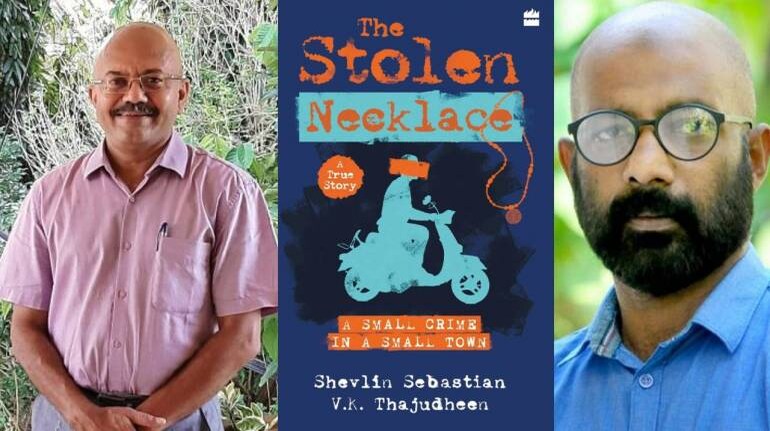
(From left) Shevlin Sebastian; his book 'The Stolen Necklace'; VK Thajudheen, on whose life the book is written

(From left) Shevlin Sebastian; his book 'The Stolen Necklace'; VK Thajudheen, on whose life the book is written

Someone known to me was imprisoned for a crime he did not commit. His family faced unbearable agony, given that he was not only the sole earning member of the family but also because he was innocent. However, the latter is a statement that can be questioned because it has elements of unrecognised bias in it.

When this person finally got bail, he told me that most people languishing in the jail premises have been falsely implicated under a criminal offence because someone had to be put behind bars. Some of these inmates have gotten used to the premises because they’ve given up hope, he told me. They know that no one can fight for them, and he felt fortunate that he had people and resources who stood up for him and got him out.

Something very similar happened with VK Thajudheen, a middle-aged man, who came back to his hometown from Doha for his daughter’s marriage. But little did he know that he’d be jailed for months for a crime he didn’t commit: stealing a necklace. The CCTV coverage presented his lookalike, and police were convinced it was no one else but Thajudheen who stole the necklace. While the police tried to extort money for him “to settle matters”, Thajudheen wanted his name to be cleared because he believed that truth shall prevail.

In The Stolen Necklace: A Small Crime in a Small Town (HarperCollins, 2023) veteran journalist Shevlin Sebastian tells his story. A poignant tale, which reads almost like fiction, narrates events as they unfold, shares relevant backstories and notes down a similar situation in the United States and what can be done to do away with cases of false implications.

In an exclusive interview with Moneycontrol, he shares what compelled him to tell this story. Edited excerpts: 

RELATED STORIES

From the vast number of cases of false implications and mistaken identities, what drew you towards Thajudheen’s story?

I selected the Thajudheen story because it was from Kerala and closer to home. We could get a wavelength easily. What intrigued me the most with this case was the conclusion one could draw — if it could be Thajudheen, it could also be you.

The book almost reads like fiction. Were you able to see or distinguish yourself from a journalist reporting findings and a writer telling a story throughout your journey of working on this book?

I used both my skills: as a reporter and a short story writer. One reader said that this marriage has created a unique style.

It’s remarkable how poised and optimistic Thajudheen remained throughout, but he was one of the lucky ones who happened to be well-connected and received support. Many people, especially the poor and the marginalised, may not have access to the people and resources he had. In such cases, how can their stories of wrongful imprisonment be brought about? And what can be a way to prevent authorities from staging the very people they’re put in place to protect as criminals?

It is true that Thajudheen was very lucky because of the powerful support he received. It is also true that the poor have suffered enormously over the decades at the hands of the police. The only way is if civil society can fight for justice on their behalf.

On multiple occasions, Thajudheen calls for a better prison environment for the jailmates’ mental well-being. However, one of the incidents from his youth also shows how little importance our society places on mental health. What do you think can be done to enable people to take mental health seriously, especially by institutions like the police and investigative agencies, as, ultimately, they’re dealing with people?

Regarding awareness of mental health, the media should do more stories about this. Mental health professionals should hold classes for law enforcement to create awareness. There has to be constant refresher courses which need to be conducted for the police, so that they develop a sensitivity towards the sufferings of people. Their problem is that they work long hours, under great stress and they are always short-staffed.

You share the statistics of Thajudheen’s story going viral on social media. In that regard, what does it mean to report on something sensitive in the age of sensationalising stories via social media?

In the age of sensationalism, I tried to write the truth. I avoided using provocative language. I tried to use simple sentences, so that readers can follow the train of thought. I believe simplicity has its own charm.

Sometimes social media is a good tool to fabricate a false story, and at other times, it comes across as the only solution to gain solidarity when everything fails, and in both cases, a vast majority has already given their verdict, then how do you view this as a tool for justice delivery?

Social media is a double-edged sword. It’s good and it’s bad. But we have to take the risk. Because it is only through social media (that) we can get the message across.

Are there any organisations in India like the Innocence Project in the United States, and, if not, what do you think can be done here to prevent wrongful arrests?

There is no Innocence Project in India. Only awareness of the need for one by journalists and civil society can make a difference.

Have Thajudheen’s family members read this book?

The family has not yet read the book.

SAURABH SHARMA is a freelance journalist who writes on books and gender.