StatCounter

http://statcounter.com/p4130240/summary/?guest=1

Saturday, October 28, 2023

Thoughts while looking at a photograph


Photos: With Tushar Gandhi, the great grandson of Mahatma Gandhi; Mountaineer Edmund Hillary with his wife Jane; Sethu Das, founder of the Friends of Tibet Foundation and Kathakali legend Kalamanadalam Gopi 

By Shevlin Sebastian

Sethu Das, founder of the Friends of Tibet Foundation, sent me a photograph on WhatsApp. It was of me interviewing Tushar Gandhi, the great grandson of Mahatma Gandhi. As I gazed at the image, my thoughts went back decades.

One day, at 9 am, in the 1980s, I interviewed Edmund Hillary, the first man to climb Mount Everest. This was in the dining hall of the Sinclairs Hotel in Darjeeling. Sitting next to him was his second wife Jane, looking tall but nowhere near Hillary’s height of 6 feet 5 inches.

Hillary’s first wife Louise and daughter Belinda died in a plane crash near Kathmandu on March 31, 1975. It was a tragedy from which Hillary never completely recovered.

Like I did with Tushar, I pointed a dictaphone at Hillary. During interviews, I always hold the dictaphone up, instead of placing it on the sofa or at a table nearby. I fear that otherwise, I will not get good audio reception.

I also lean forward and encroach on the other’s space. With men, it is fine. But with women, I always say, “Madam, I am sorry I have to come closer, because of the dictaphone.” Thereafter, the women are fine.

One benefit of holding the dictaphone is that I can always check whether the red light, which shows a recording is taking place, is flashing. In a few interviews over the years, I have forgotten to press on the recording button. But within minutes, I can detect the mistake. Then I press the button, offer my apologies, and restart the interview from the beginning.

Today, I keep the same habits from three decades ago.

To prepare for my interview with Hillary, I went to the library of Ananda Bazar Publications (ABP) at Kolkata and asked for the clippings file on him. I was working for Sportsworld magazine, an ABP publication.

This was during the pre-Internet era. So I read up all that I could about Hillary. And then as I prepared the questions, I asked myself this question: ‘What is it I want to know?’

In Hilary’s case, I realised I wanted to know whether he was aware of death during his ascent to the peak of Mount Everest. When I put this question to Hillary, his eyes widened. This was not something he was expecting a young man to ask.

This was what he replied: “I was frightened. I knew one mistake would result in me plunging to my death. So, the triumph is not only over the mountain, but over all the fears and anxieties that are raging inside you.”

It was a memorable answer.

For Tushar, it was a simple decision about what I wanted to know. The state of India at present. But this was what most people, especially liberals like me, would ask him. But as I did my research on Tushar, I came across an interesting item.

The police had detained him on August 9. He was about to take part in the Quit India celebration at Kranti Maidan in Mumbai. I wondered what it would be like when the police detained you. So, I asked him about this experience in depth. And that became the beginning of my article.

After the interviews, the process was the same. I would transcribe the conversation, make it an article, and file it. And the years went by with no major hiccups.

Except once.

In July, 2009, I travelled to Mundur, near Thrissur to do an interview with Kathakali legend Kalamandalam Gopi. This was for my column, ‘Turning Points in Life’ for the ‘New Indian Express’. I had an enjoyable meeting with him.

I returned to Kochi by train, rucksack on my back, and took a bus to the office. Although there was no seating space, there were few standing passengers. When I got down, something prompted me to check the pocket of the rucksack. And the unthinkable had happened. A pickpocket had filched the dictaphone. It was the first time I experienced the meaning of the term, pole-axed. Something similar would be to have a hollow feeling at the pit of my stomach. Or rather, I felt I had no stomach. ‘How did it happen when the bus was not crowded?’ I asked myself.

I did not know how I would write the article. I was so dependent on the dictaphone that I hardly remembered the conversation. Through a crime reporter colleague, I filed a police complaint. But, of course, nothing happened. Why should cops bother about a lowly scribe and his silly dictaphone?

So, this is what I did. The first half of the article was a mood piece about my encounter with the maestro and his wife inside the house.

Here it is:

‘At Mundur, near Thrissur, Kathakali legend Kalamandalam Gopi welcomes me with a smile to his home, ‘Guru Kripa’. He is wearing a maroon shirt and white mundu.

We settle down on a sofa and soon the interview begins. About twenty minutes into the conversation I tell him I am unable to follow what he has said. Irritated, Gopiyasan says, “There is nothing more I have to say. I have a sore throat and feel tired.”

It is at this delicate moment that I mention the name of my former colleague, Sreevalsan Menon, a passionate Kathakali fan. He has known Gopiyasan from his childhood.

A few weeks ago, Sreevalsan sent me a wake-up SMS at 4.45 a.m. He was keen to introduce a neophyte like me to the power and magic of kathakali.

There is a Gopiyasan dance being telecast at 5 a.m. And so, with sleep-laden eyes and a stiff body, I switch on the television.

For the next one hour Sreevalsan is on the mobile phone explaining every nuance, mudra, gesture and facial expression. Thanks to this class I am able to appreciate Gopiyasan’s genius.

When Gopiyasan hears this anecdote, he bursts out laughing. His equilibrium restored, the interview resumes once again. He talks with an infectious enthusiasm and joy, and poses for photographs, with his dazzling smile. And so, it is with a grateful shake of his hand that I take his leave and return.’

For the second half, I tried to recall whatever I could. Then I took some material from Wikipedia and completed the article.

As for the thief, I think about him even today. Was he able to sell the dictaphone? It was an old one. How much would he have got for it? It is now 13 years since the theft happened. Is he still getting on buses and stealing from unsuspecting passengers? He could be married now, with children. What would the children think of him, if they come to know their father is a pickpocket?

And one day, surely, his luck would run out, as alert passengers might catch him in the act and get him arrested. Has he spent time in jail? Did he have moments when he felt he should leave thieving and try something respectful? Who knows?

People make choices and pay the price for it. The dictaphone has probably outlived its usefulness and must be lying on some trash heap.

That is life. We do things to survive and if the actions are positive, there are no repercussions.

At the end of the interview with Tushar, as if on cue, the waiter arrived. He had a look of awe on his face. ‘The Mahatma’s mystique remains,’ I thought.

The waiter served black coffee and banana fritters. We ate and drank and talked about a variety of subjects including his recent chat with Uddhav Thackeray, the former Chief Minister of Maharashtra.

I felt thankful when I bid goodbye. Thanks to my work as a journalist, I have interacted with so many well-known people. Many of them were high-achievers. Some were geniuses. All pulsated with vibrant energy and infectious enthusiasm. Every day was a joy and a miracle for them.

As for me, the excitement of journalism has not waned. I know of reporters, who have been on a daily deadline for decades, who have burnt out. I may have escaped that fate because I was in feature writing all along. I managed to avoid doing hack work, which can be soul-sapping.

And I thank God for that.

Thursday, October 26, 2023

A touch of Tibet in Kochi


Photos: Sethu Das (in blue shirt), founder of the Friends of Tibet Foundation shows the Zenith Radio to the Dalai Lama; the Potala Palace in Lhasa. Photo by Jaqueline Meier of Switzerland; A father, mother and 12-year-old son who had arrived at the Tibetan Refugee Reception Centre in Kathmandu, Nepal, after trekking over the Himalayas. Photo by Angel Lopez Soto from Spain; a thangka painting

The Friends of Tibet Foundation has set up a museum and a library about Tibet. Tushar Gandhi, the great grandson of Mahatma Gandhi, and human rights activist inaugurated it on October 22
By Shevlin Sebastian
It is a cloudy Sunday afternoon. Panorama Nagar in Kochi is deserted. There are bungalows lining the road. Most houses have grassy lawns, gardens with roses, sunflowers, and marigolds, apart from mango and coconut trees. Silence abounds. Only the chirp of sparrows can be heard. Everybody is taking their afternoon siesta. In front of one bungalow, set at quite some distance from the road, white, red, blue, green and orange flags are fluttering on a wire.
This is the first hint that there is something different about the bungalow.
And, indeed, it is different. The bungalow houses a museum which is dedicated to showcasing the life and times of the people of Tibet.
According to their history, the Chinese invaded and captured Tibet in 1950. Thousands of Tibetans died. Many fled, trekking over their Himalayas, and took refuge in India. In 1959, the Tibetan spiritual leader Dalai Lama sought political asylum in India. It was granted to him. He fled from Lhasa, the capital of Tibet, and trekked over the Himalayan mountain passes and reached Mussoorie. According to government data, there are 85,000 Tibetans living in India today.
Inside the museum, one of the first things that catches the eye is Zenith Royal 1000-1 Wavemagnet Transistor Radio. The current Dalai Lama used it when he lived in the Potala Palace in Lhasa. He took it with him when he came to India and established a government-in-exile in Mussoorie, in the state of Uttarakhand in northern India. In 1960, it was shifted to Dharamshala in Himachal Pradesh.
“The Zenith Corporation made it for the exclusive use of the Dalai Lama,” said Sethu Das, the founder of the Friends of Tibet Foundation. “It was one of the most powerful radios built at that time.”
Sethu pulled out its very long antenna. “This was how the Dalai Lama kept in touch with all the happenings in the world,” he said.
On November 25, 2012, the Dalai Lama visited Kochi.
Sethu said, “Your Holiness, do you remember this radio?”
The Dalai Lama shook his head.
Sethu said, “This is your radio.”
The Dalai Lama laughed heartily, as he hadn’t expected to see the radio in Kochi. The Dalai Lama’s sister, Jetsun Pema, had gifted it to the Friends of Tibet several years ago.
On October 22, Tushar Gandhi, the great grandson of Mahatma Gandhi and a noted human rights activist, inaugurated the museum.
When Tushar saw the radio, he said, “I feel nostalgic when I see the Dalai Lama’s radio. It reminds me of the clandestine radio broadcasts by the courageous Congress worker Usha Mehta in Mumbai 75 years ago."
Usha had set up the Secret Congress Radio, an underground radio station. She broadcasted the communications of the leaders, many of whom were in prison. It functioned for eight months during the Quit India Movement of 1942.
“Today, the Tibetan movement symbolises the battle of right against might,” said Tushar. “The world must sympathise with the Tibetan people. We Indians must make the battle to regain the homeland of Tibet for the Tibetans our own. We must help to achieve this dream during the lifetime of His Holiness The Dalai Lama. I affirm my solidarity with the people.”
At the museum, next to the radio, in a framed photo, are images of Tibetan currency. You can see paper notes like 25 and 100 Sang notes. They were in circulation till 1959.
There is a long-distance shot, by Jaqueline Meier of Switzerland, of the magnificent Potala Palace. It is located high up on the Red Hill. In the massive courtyard in front, there is a group of Chinese police officers standing around. This is a stark reminder of the invasion. Thousands of Tibetans died at the hands of the Chinese troops.
One of India’s greatest spiritual teachers, Osho, said, in a speech at Pune, in 1988, “Tibet has fallen into darkness. Its monasteries have been closed. The Chinese have forced its seekers of truth to work in labour camps. Nowhere in the world has there been such a concentrated effort to discover man’s inner being. But the communist regime has destroyed everything that the people had built in the past two thousand years.”
In another image, taken by Angel Lopez Soto from Spain, a father, mother and 12-year-old son had arrived at the Tibetan Refugee Reception Centre in Kathmandu, Nepal, after trekking over the Himalayas.
They are sitting on a bench and having soup, their eyes cast downwards towards the bowls. They looked weather-bitten and hungry. The father has placed his foot in a basin of warm water.
“He may have suffered from frostbite,” said Sethu. “This is a scene from the 1960s.” A young woman, in a white top and floor-length skirt, stood on one side and watched them with a solicitous look on her face.
On another wall hangs a thangka. It is a Tibetan Buddhist painting which is painted on cloth. It depicts Lord Buddha, who is sitting crossed-legged inside a lotus. “They make the paints from natural plants,” said musician Nirmal Anthony, a member of the Friends of Tibet. “The lotus is a flower that grows in the mud but is untouched by it. Buddha’s message is: ‘You should live in the world but remain unaffected by its vicissitudes.’ The thousand-petalled lotus symbolises the enlightened state of human consciousness.”
There is also a photo, taken by Mumbai-based photographer Suresh Natarajan, of a smiling Dalai Lama, sitting on an armchair in his office in Dharamshala. The Dalai Lama radiates positive energy because of his twinkling eyes. He looked to be in his fifties. A copy of the American magazine, Newsweek, is lying on a low table in front of him. Today, the Dalai Lama is 88 years old.
Other photos show the vistas of the Tibetan landscape with its blue skies and high mountain ranges.
Some items have been placed on a table. These include the first Tibetan passport used by the Finance Secretary Tsepong Wangchuk Dedhen Shakabpa; the 1934 September edition of the National Geographic magazine carrying the image of the Tibetan National Flag in the ‘National Flags of the World’; Chinese Communist Party Chairman Mao’s ‘Little Red Book’, and a uniform worn by the Chinese soldiers during the invasion of Tibet.
A visitor’s view
Sudheer Nath is a Delhi-based journalist cum cartoonist. Once or twice a month, he comes to Kerala to visit his family. He dropped in to view the museum.
“If you visit the museum without knowing the history of Tibet, you will not get an idea of the pain and despair behind the photos,” he said. “It will be ordinary photos for those who are ignorant. But for me, it was a deeply moving experience.”
Sudheer has been a keen follower of the Tibetan issue for 25 years and has attended many functions of the Friends of Tibet. He has visited the Tibetan refugee colony called Majnu Ka Tila near Kashmere Gate in Delhi. “I am a supporter of Tibetan independence,” he said.
There is also a library which houses hundreds of books about Tibet. You can see ‘A Journey in Ladakh: Encounters with Buddhism’, by spiritual teacher Andrew Harvey; ‘Tibet: Reports from Exile’ by Tibetan author Thupten Samphel, and ‘The Definitive Account of the Dalai Lama and Tibet’, written by American journalist John F Avedon. There is a book by the Dalai Lama, called ‘Awakening the mind: Lightening the heart.’
Attracted to Tibet
Sethu was working as a graphic designer with the ‘Economic Times’ newspaper in Mumbai. During a vacation, he landed in Dharamshala with a photographer friend. That was when he encountered Tibetan monks with their distinctive maroon cloaks. He got curious and did interviews to know more about them.
When some of them refused to speak, he realised later the Chinese had cut off their tongues. He felt an ache in his heart. “I discovered my life’s work and passion in Dharamshala,” he said. Soon, he gave up his job. Thereafter, he set up the Friends of Tibet at Mumbai in 1999. This was followed, in the same year, by the setting up of the Friends of Tibet Foundation in his hometown of Kochi.
The Foundation works to safeguard and advance Tibetan heritage, including their healing traditions.
“We are conducting research on the unique heritage, legacy and history of Tibet,” said Sethu. The Foundation works with scholars, scientists, health experts, and sociologists to publish research papers.
During the Kochi International Art Biennale, in December, 2022, the Foundation set up ‘Shadow Circus: A Personal Archive of Tibetan Resistance (1957-74)’. Activist film-makers Ritu Sarin and Tenzing Sonam curated it.
Karma Yeshi is a former finance minister of the Tibetan Government in Exile. He said that the Friends of Tibet are doing wonderful work, mainly in South India and Mumbai. ‘They have made the people aware of the sufferings of the Tibetan people,” he said. “All this has happened because of the immense dedication and sincerity of Sethu and his team, Suku, his brother, and their father CJ Yesudasan (1938-2021), one of Kerala's well-known cartoonists. Because of them, many other people have joined the group. All of them are so sincere.”
------------------------------------
Box
Tibetan Medical Camp
Next to the museum is a doctor’s chamber. Dr. Dorjee Rapten Neshar conducts a three-day medical camp once every two months.
“Sowa Rigpa, or the Science of Healing, is one of the world’s oldest known medical traditions dating back to the 4th Century AD,” said Dr. Neshar. “The Indian healing system of Ayurveda has influenced Tibetan medicine. We use pulse and urinalysis. Our medicines are composed of herbs and minerals. We have physical therapies like acupuncture.”
Around 100 patients come to seek treatment.
One of them is Sreelal. He is an artist and teaches art at the Emmanuel College at Vazhichal, 43 kms from the capital of Thiruvananthapuram. On the evening of February 4, 2022, after returning from college, he complained of a headache to his wife, Chitra. So, he lay down on the bed. Suddenly, there were tremors on his face and blood shot out from his mouth. Chitra took him to the hospital. The hospital could not diagnose whether it was a stroke or a fit.
“Since it was during Covid, the doctor put him on a ventilator,” said Chitra, who works in a government office. After 15 days, the doctor took him off the ventilator and Sreelal became normal after a month.
“Through the next year, now and then he would have fits,” said Chitra. ‘Sreelal began slurring on some words. The hospital kept increasing the dosage. Sreelal became bedridden and slept a lot. He became absent-minded.”
Mathew, a friend, suggested that they consult Dr. Neshar.
“We were hesitant to bring him,” said Chitra. “I had not heard of Tibetan medicine earlier.”
But on July 5, this year, Chitra brought Sreelal to the medical camp in Kochi. When Dr Nasher inspected Sreelal, he was shocked at the high dosage of medicine that he had been taking. He reduced the dose and also provided Tibetan medicines. The tablets have to be grounded and immersed in warm water. Sreelal took the liquid three times a day.
Within days, there was a marked improvement. Sreelal is also doing physiotherapy. He can walk now. “He is eating with his left hand, even though he is right-handed,” said Chitra. “I don’t know what it is, but Tibetan medicine is amazing. I am sure Sreelal will make a complete recovery.”

Monday, October 23, 2023

Chronicling the Cochin Jews


Pramila Venkateswaran’s book of poems, ‘We are not a museum’, has won the best poetry award at the New York Book Festival
By Shevlin Sebastian
(Published in scroll.in:
On the morning of July 26, when Pramila Venkateswaran opened her eyes, she saw it was dark outside the window of her house in Long Island. There was a steady pitter-patter of the rain. Pramila was glad that because of the summer holidays, she did not have to go to work. She is Professor, English and Women and Gender Studies at Nassau Community College 58 kms away.
She went to the kitchen and made herself a cup of coffee.
After a while, her husband IV Ramakrishnan came in, carrying a black briefcase. He was wearing a blue shirt and black trousers. Pramila liked the way he kept his white beard so trim and proper. Ramakrishnan is Professor and Associate Dean in the Department of Computer Science at Stony Brook university. It was a five-minute drive away.
“Happy birthday,” he said, as he gave Pramila a peck on her cheek.
“Let’s go out for dinner today.”
“Okay,” said Pramila. “Hopefully, the rain will stop by then.”
“I think it will,” he said, as he headed towards the door.
Carrying her cup of coffee, Pramila went to her study, opened her laptop and checked her mails.
One email said she had won an award. She thought, ‘What is this? I don’t remember applying. This can’t be true.’
Anyway, Pramila clicked on the link. She realised she had won the first prize for poetry for her book, ‘We are not a museum’. This was in the competition held by the New York Book Festival.
Pramila had sent an entry over ten months ago. So she had forgotten about the event. Immediately Pramila thought, ‘What a perfect birthday gift!’
She sent the link to her daughters living in different parts of America and to her husband. She also posted the link of the award online. Soon, congratulatory messages rolled in.
The book is about the life and times of the Cochin Jews, a declining community. There are less than 15 members left. As a child, she spent a few years in Jew Town.
“I would run in and out of the Paradesi Synagogue,” she said.

Her father, R Venkateswaran, worked as a manager in Canara Bank. The management had transferred him to the Fort Kochi branch. “He became close to the Jewish community,” she said. “And especially with Satu Koder, a leading entrepreneur, who was the warden of the synagogue for over 40 years.”
Both worked together, in 1968, to celebrate the 400th anniversary of the synagogue. Prime Minister Indira Gandhi was the chief guest. For several years after that, in her parents’ house, there hung a large black-and-white photograph. This comprised Indira Gandhi, Venkateswaran, his wife, Kausalya, and Satu Koder standing together.
What Pramila remembered was how entranced she was by the inside of the synagogue. She recollects the memory in this excerpt from her poem, ‘I was seven’ from her book.
Oh,
there is so much gold and red in this temple,
the tall lamps are lit and multicoloured glass dance
their hues on the windows. How strange
the objects in the room—the tall table, the big book,
the writing on the walls. I do not even know
what building we’re in until Amma explains,
“It is a synagogue, a Jewish temple.” I carry the sound
of my light steps, velvet in my eyes.
For the past 20 years, Pramila had been writing poems about her childhood. Inevitably, she wrote about her time in the synagogue.
She had no plans to write a book about the Cochin Jews, but as she reflected on the rich syncretic tradition in Kerala, where the mosque, church and the synagogue stood side by side and in harmony, Pramila felt she should do so.
In 2009, when she visited the synagogue, she saw tourists from all over the world. Pramila said, “I thought, ‘Oh my God, people are coming there to view it. But there are actual Jews who are living there.’ Hence, the title of the book came up, ‘We are not a museum’.”
And here is the poem:
We are Not a Museum
The whole world seems to have landed on our doorstep.
How did this happen? Yesterday a woman was peeping
into my bedroom. Now I close my doors and windows
to keep out nosy tourists creeping around Mattancherry.
A journalist called asking me about my life in Kochi.
I said it is like any other woman’s. I have a huge load
of laundry to wash, dishes to scrub, chickens
to pluck. I’ll rest only in the grave. So goodbye.
I don’t care if they think we are strange or important.
It is absurd. We’re like any other Indian in this town
struggling to make life better for our children. I want
the lot of them out of this town and out of our lives.
Pramila began researching the history of the Cochin Jews. She read books about anthropology, history, sociology and ethnographies related to Jewish women from Cochin and people who moved to Israel from Cochin.
When Pramila was studying at Bombay University, she came in touch with the Bene Israel Jews. Her English Professor, Nissim Ezekiel (1924-2004), one of India’s well-known poets, was a Bene Israel Jew. “He was my mentor,” she said. “So, I felt very close to the community.” In New York, Pramila has befriended other Bene Israel Jews like the poet Zilka Joseph.
Not surprisingly, Pramila wrote about Anti-Semitism in ‘The Face of the Other’:
the face speaks to me and thereby
invites me to a relation…
Emmanuel Levinas, ‘Totality and Infinity’
Why do some see yellow stars
instead of faces, their marauding pens
marking the city’s walls with swastikas?
Hate clouds barrel down the ages
from the Black Sea and Ararat, from the Nile
and Babylon. It storms in
among starched shirts and rags.
Why is a Jewish child selected
to be erased? Philosophers say
to love is to see the other in oneself. But
the other blends into the unknowable.
I ask, doesn’t a child crying for his mom
on any street around the globe
make you wince?
Asked about the themes, Pramila said it was an emotional experience of what it is like to be a Jew in Cochin. “I was putting my imagination into the writing,” she said. So Pramila imagined the first immigrants coming to the Kerala coast.
One poem looked at the paintings of the Cochin Synagogue. A few poems talked about how persecuted Jews embarked on perilous journeys from Iraq and modern-day Palestine to India.
Another poem described the impact of the presence of the Portuguese, the Spanish and the English from the 15th to the 18th centuries.
“There was fighting between these European colonists,” said Pramila. “The Jewish community was caught in between. The Portuguese torched their synagogues in Cranganore and they fled by boat to the Cochin harbour.”
Pramila wrote a poem about the generosity of the King of Travancore.
Chorus: At the Palace of the Raja of Cochin
Rajadi Raja, your royal highness Ramavarma Kulashekara Perumal,
we bow before your blessed feet. The morning breezes bring
tidings of something new to our Keral coast. Men
and women with children arrive in boats, speaking a
tongue we have not heard before. They look like merchants
from Arabia, but are different. The men wear caps
on their heads and the women wear long, pale skirts,
have dark eyes like the apsaras in your court,
wear no ornaments in their dark brown and black hair,
and walk with a firm gait beside their men.
Rajadi Raja, the men are at the palace gates and ask
to pay their respects to you. They bear baskets of dried
fruit, dates, almonds, pistachios, apricots and olives,
saplings of plants that may or may not grow here,
seeds and coins. Their hands that bear the stain of labour,
lovingly hold their children. They speak words we
don’t understand, but there is grace in their speech
and beauty in the treasures they bear for your majesty.
We will open the gates for their visit, so they gather
in the shade of the palace courtyard and await your presence.
We bow to you, sire, lord of the Keral coast, master of our
blessed land of Parasurama who continues to bless us.
The King looked at them with sympathy.
“He felt they were worthwhile people who needed help,” said Pramila. “So, he gave them land to settle down. He allowed them to build a synagogue. And the Jews prospered. It was a very different engagement for the Jews with the outsider. It was so different from what happened in Jewish history in other countries.”
The surrounding communities were so varied. The Jews interacted with Muslims, Christians, Buddhists, members of the Gujarati community and the Konkanis from Goa. “I have written poems that bring out this varied culture,” said Pramila. “I also wanted to distil the historical record through poetry.”
There are 35 poems. And the book has been well received.
‘This is a sensitive and well-crafted collection. ‘We are not a Museum’ skillfully and thoughtfully blends two cultures into one with its unique juxtaposition of the two,’ wrote poet Kavita Ezekiel Mendonca. ‘The closeness and the shared bonds between the poet’s community and the Cochin Jewish community in her hometown in India become a timeless fabric of personal and universal history. The poet’s knowledge of the Jewish community is evident in each poem. I can almost smell the aroma of spices as the Jewish immigrants make their way to the Zamorin’s palace.’
Another poet Marjorie Agosin said, “An exquisite collection of poems, where history and lyricism dwell in the memory of the Jews of Cochin, where time and centuries of persecution have tried to erase them. Pramila Venkateswaran is a poet of resilience and of hope.
"Each of these poems engages the reader in the sensual landscape of Cochin, the smell of oranges and pomegranates as well as the poignant stories of those that lived in these places and those that return through memory and poetry. A poetry that moves your soul and enchants your heart.”
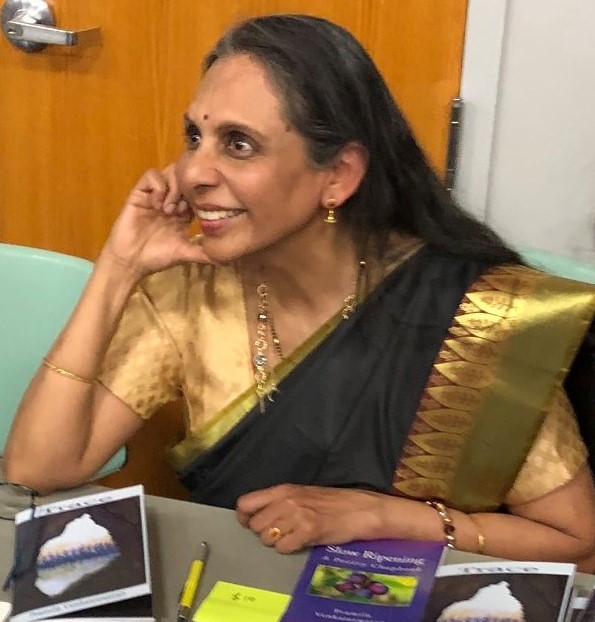
Pramila is an established poet. Her other books include ‘Thirtha’ (2002), ‘Behind Dark Waters’ (2008), ‘Draw Me Inmost’ (2009), ‘Trace’ (2011), ‘Thirteen Days to Let Go’ (2015), ‘Slow Ripening’ (2016) and ‘The Singer of Alleppey’ (2018).
Of course, the road to publishing has been difficult, because poetry has no market. For her first book, she approached around 50 publishers before she got Yuganta Press to publish it. The same thing happened for ‘Behind Dark Waters’, her next book. She approached publishers on three different continents. Finally, a publisher in Texas, Plain View Press, published it.
“The third and fourth were not that hard,” she said. “But my latest manuscript, tentatively titled ‘Walls’, I have been trying for the last two years, and have made no headway.”
Pramila said her win will not make any impact on the chances of publishing. “You are back to the drawing board all the time,” she said.
Asked about the poetry reading public in the US, Pramila said, “It is miniscule, when compared to the readers of the novel and short stories. This is the case with most countries, including India.”
Incidentally, the rain did stop and the couple enjoyed a celebratory dinner at Sagar Indian restaurant on Long Island.

Saturday, October 21, 2023

Podcast Interview regarding writing

One of America’s pre-eminent authors of the 20th century, John Updike (1932-2009) once wrote, “In America, one of the wealthiest countries in the world, less than 100 people have been able to survive by writing alone.”
In India, thanks to the OTT boom, many writers are earning their living by working as scriptwriters.
One of them is K Hari Kumar. He has been the screenwriter for three films, a script consultant for multiple web series and is the author of seven books, mostly in the crime and horror genre.
Three books are in the pipeline.
Now Hari Kumar is venturing into the audio and video space.
I was happy when Hari Kumar interviewed me for his new podcast called ‘The Story Vault’. In it, we discuss the nuts and bolts of writing a non-fiction book and a host of other topics.
Thank you Hari.
Please listen on these links:


Sunday, October 01, 2023

Frontlist Magazine interview


Many thanks to Frontlist Magazine for this interview: 


https://www.frontlist.in/magazine/32