StatCounter

http://statcounter.com/p4130240/summary/?guest=1

Thursday, January 08, 2015

It’s a Sunny World


Diamond Merchant PP Sunny talks about the ever-lasting charm of the gem. More people are buying diamonds these days

By Shevlin Sebastian

Photo by Melton Antony 

A few years ago, Kanthi Balakrishnan went to hear a concert by singer KJ Yesudas at Hyderabad. At the interval, she met Prabha Yesudas, who was wearing a glittering diamond necklace. A curious Kanthi asked for the jeweller’s name. It was the Kochi-based PP Sunny, the chairman and managing director of Sunny Diamonds Pvt. Ltd. Their retail outlet, a three-storeyed white-painted building on Rajaji Road, is impossible to miss when you go past.

So Kanthi, who is 90 now, contacted Sunny and asked for a bangle. After making it, when Sunny was about to send it, Kanthi requested a personal delivery. So, when Sunny next went to Hyderabad, accompanied by his wife, he presented it to her. Later, when Kanthi came to Kannur for treatment, she asked for some more jewellery.

Once you start buying diamonds, you will keep buying it all the time,” says Sunny. “Diamonds are forever. My finger ring, after several generations, will remain the same. This is unlike gold, which can be melted.”

As he talks, in his first-floor office, a call comes on the intercom. Sunny goes down to the shop floor to meet Pattabi Raman, a former chairman of Dhanalakshmi Bank, whose wife has come to buy some jewellery.

When he returns, Sunny says, “When I decided to launch Sunny Diamonds, Pattabi Sir gave me advice which I took to heart. He said that when you embark on a retail outlet, you should have double the assets. In other words, if you are investing Rs 50 lakh, one should have assets of Rs 1 crore. The idea is that in case, the business fails, you can pay off the debts.”

There are two ways to start a retail outlet. One method is to take a loan from the bank and start with a rented building, with limited furnishing and investment. When you get a good profit, you can pay off the loan. “The other way is the way I did it,” says Sunny. “I bought land, and made a building. The reason is because I am not working for my generation, but for the next one, too.”

Sunny has three children. While the eldest, De Paul, 26, lives and works in New York, Prem, 21, is doing his Bachelor’s in Business Administration while Rohan, 12, is in school. 

And things are going well. On January 9, Sunny Diamonds will celebrate its tenth anniversary. The company has retail outlets in Thiruvananthapuram and Kozhikode also.

And in order to generate sales, Sunny began a unique Money Back Guarantee. “You can bring back the diamond at any time and I will pay back the price,” says Sunny. “If a customer feels he has been cheated, he can return the diamond. My shop is like a trading facility. Other jewellers cannot do this, because they have a huge profit built into the selling price.”

So how does he manage? “I make my margins at the buying point and not at the sale,” he says. However this money-back is not available for solitaires, uncut diamonds, polky and rose-cut diamonds. 

All sorts of people are his customers. They include middle-class professionals, women who could not afford diamond jewellery earlier, businessmen and even farmers.

Sometime ago, a farmer and his wife came from Kattappanna. “They said that they did not know much about diamonds, but their Bangalore-based daughter wanted a diamond for her wedding,” says Sunny. “They were giving Rs 5 lakh as dowry, out of which Rs 3 lakh was in the form of diamonds. They chose a wedding set.” 

In fact, 50 per cent of the sales of Sunny are of wedding sets: necklace, earrings and finger ring. The price range is from Rs 45,000 to Rs 4.5 crore.

While getting photographed, next to a shining necklace, with green emeralds, Sunny says, in a casual voice, “This is about 35.” Then he pauses, and adds with a smile, “Lakh.”

Sunny usually deals in Belgian diamonds, because, according to him, they are the best in the world. “If you want to know whether a diamond is internally flawless, you have to verify each and every diamond manually,” he says. “I can do this because the manpower cost is less in India than in other countries. Abroad, this will cost $10 an hour and I cannot afford that.”
Before a customer buys a diamond, he has to look for the four C’s: Cut, Colour, Clarity and Carat Weight.

Cut:  Diamonds are renowned for there ability to transmit light and sparkle intensely. “The quality of a cut is crucial to the diamond's final beauty,” says Sunny. “Of the 4Cs it's the most complex and technically difficult to assess. Cut is often confused with the shape of the diamond.”  

Colour: The colour gives an idea of the beauty and brilliance of a diamond. “However, colourless diamonds are of the highest purity,” says Sunny. “But they appear white most of the time.”

Clarity: There are surface defects known as blemishes. The less the blemishes, the higher the price.

Carat: A carat weight is the measurement of how much a diamond weighs. A metric carat is equivalent to 200 milligrams.

Meanwhile, when asked for reasons behind his successful enterprise, Sunny says, “You should be sincere and honest. It is with these twin qualities that you will gain a name, trust and credibility. If you become greedy and make money at all costs, then you will not succeed in the long run. Secondly, you should be dedicated at all times to your work.” 

(The Indian Express, Kochi and Thiruvananthapuram)  

Wednesday, January 07, 2015

Loved By The Public

COLUMN: Spouse's Turn 

Film director Boban Samuel talks about life with the actor Reshmi

By Shevlin Sebastian 

Photo by Mithun Vinod 

One night, in 2007, film director Boban Samuel went to the terrace of his house in Thiruvananthapuram. He was accompanied by his wife, Reshmi, and their two small boys. He was feeling low. His career was going nowhere. Boban looked up at the sky and saw that it was cloudy. “My life has become like the sky,” he told Reshmi. “I have no work. I don't know what to do.”

Reshmi said, “Everything will become all right.”

Suddenly, in between the clouds, a small star appeared.

Reshmi saw it and said, “There is one star. So there is hope that something will happen.”

Boban nodded. Suddenly, his mobile started ringing. He looked at it: it was an Ernakulam number. He did not want to take it. Reshmi urged him to do so.

So Boban took it. The call was from a production controller of television serials. He said that Chavara Advertising wanted to do a serial on a Christian theme and would Boban come to Kochi the next day to meet the producers, Sibi Chavara and George.

Boban was not interested in doing religious serials. But Reshmi prodded him to go. At Kochi, Sibi told him that it would be on the life of Sr. Alphonsa, who was made a Saint on October 12, 2008, by Pope Benedict XVI.

Boban said that he had no idea about the life of this nun. So they gave him a book --  Snehabaly’ by Father Romulus. On the train back, he read the book and realised there were incidents in the nun’s life which could be made into a serial.

When the serial was telecast -- 101 episodes of one hour each -- it became a hit. “Because, at this time, Sr. Alphonsa was declared a saint,” says Boban. “So the timing was perfect.”

Soon, the actress Reena offered him a film. Boban met the actor Jayasurya. Thankfully, the actor's wife, Saritha, was a fan of the Alphonsa serial. So, Jayasurya agreed to act in Boban's first film, ‘Janapriyan’. The film was well received and Boban's career took a different turn.

The sighting of the star, such an accidental event, was the turning point in my life,” he says.

Meeting Reshmi was also an accident. In 1999, Boban was working as an associate director for a TV serial, ‘Peythozhiyathe’, in Thiruvananthapuram. They needed two fresh faces. “So we got a lot of photographs from all over,” says Boban. “Among the lot, there was one of Reshmi, who was working as an anchor in Surya TV. I looked at the photo and felt that it did not suit the character and said so.”

However, after a few episodes, the director KK Rajeev introduced a new female character. “This time, we selected Reshmi,” says Boban. And when they met, there was an immediate attraction between the two.

It was during this time that Boban was looking to get married. In two months, he proposed to Reshmi. But there were family objections from her parents. While Boban is a Christian, Reshmi is a Hindu (Nambiar). But Reshmi stood firm. And finally her parents accepted her decision graciously.

The marriage took place at Thiruvananthapuram on January 29, 2001. Soon, after the wedding, they went to the cemetery where Boban’s father was buried. He had died when Boban was 14. “It was the first time that Reshmi was going to a cemetery,” says Boban. “Later she told me that she felt that she was getting some blessings from my father.”

Today, the couple presents a happy image at their 12th floor apartment in Kochi. They sit on adjoining sofas, smile often at each other, and finish each other's sentences.

Asked to list the plus points of Reshmi, Boban says, “She had come into my life before I became a film director. So she saw my struggles. Reshmi was supportive in those difficult times and she is supportive now. I am grateful for that.”

Reshmi is a good mother to Nidheesh, 13, and Akash 9. “She ensures that they do their studies well and provides good food for them,” says Boban. “I am not very good at being a parent. I get immersed in my work and become distracted.”

Reshmi is also a good cook. “At the time of our marriage, she did not know cooking at all,” says Boban. “She made a chutney, of onion and tomato, and as soon as I had it, I spat it out. The mistake was that she had not added tamarind. But today she is a No. 1 cook. And I like her fish curry the best.” 

When the family has free time they go out to eat at restaurants and see films at multiplexes. And, increasingly, Boban is being recognised.

Sometimes, people come up and talk about my films,” he says. “Many have said that they liked ‘Janapriyan’ the most even though ‘Romans’ was the hit film. Some will ask for a role. Others will say that they have written a script and ask whether I would like to read it. It is rare for a man behind the camera to be recognised in public. So it is a big morale-booster for me.” 

As for tips for a successful marriage, Boban says, “Think of this: brothers and sisters are all so different from each other. Then imagine a person who comes from another family. How different he or she will be. So, to get along well, spouses have to learn to adjust to each other. There should not be ego tussles. When there are fights, you should come to a compromise quickly.” 

(The New Indian Express, Kochi and Thiruvananthapuram)

Tuesday, January 06, 2015

Staring Into The Vortex


Sculptor Anish Kapoor talks about his work at the Kochi Muziris Biennale and says that Indians need to develop confidence in their contemporary culture

By Shevlin Sebastian

Photo: With Anish Kapoor. Photo by Ratheesh Sundaram 

Anish Kapoor looks a bit anxious, as he stands besides a nine-feet high container. It is embedded in the floor of a large room of the Aspinwall House, a site of the Kochi Muziris Bienalle. A propeller, which has been placed at the bottom of the container, that contains blackish water, is not turning at the speed that Anish wants. Workers mill around. Anish has a chat with his assistants. Instructions are passed. Nuts are tightened, wires are re-laid, and buttons are pressed. Finally, everything falls into place.

As the propeller increases in speed, there is a swirling effect in the water, and, right in the middle a vortex is formed. A visitor says, “When problems mount up in life, it would seem as if we are sucked into a vortex.” When Anish hears this, he nods, smiles and says, “As human beings we bring all our meanings and possibilities to a work of art. Artists have to provide the scene in which those things can arise.”

Incidentally, the work, 'Descension', is the first that Anish has specifically made for an event in India. And he looks happy. “I have always had a connection with Fort Kochi,” he says. “My father was in the Indian Navy. And I remember coming here when I was ten years old and staring at the sea.”

Like the place, Anish also loves the Biennale and states that it is making an important statement. “India has a wonderful old culture, but there is almost no confidence in contemporary work,” says Anish. “In arts, music and architecture, we are stuck in the past. Bollywood is just not enough to give a re-interpretation of the past. What this Bienalle is saying is that we must have confidence in today's culture.

Anish is one who has never been short of confidence. Born in Mumbai, to an Indian father and a Jewish mother, he studied in the Doon School at Dehradun. In the early 1970s, after a brief stay at a kibbutz in Israel, he moved to London to study at the Hornsey College of Art, followed by postgraduate studies at the Chelsea School of Art, London.

In the 1980s, his work consisted of geometric sculptures, made of granite, limestone and marble. And soon he made his mark. In 1990, he was awarded the Premio Duemila Prize at the Venice Bienalle, and the prestigious Turner Prize in 1991.

His well-known sculptures include the Cloud Gate (Chicago's Millennium Park), Sky Mirror (Rockefeller Centre in New York), and the ArcelorMittal Orbit, situated at London's Olympic Park,which, at a height of 376 feet, is the largest public art project in Britain. Each of his works sells for two million pounds, on an average, and his net worth is estimated at 100 million pounds. In 2013 Anish was knighted by Queen Elizabeth for his services to the visual arts. And this year, he received an honorary doctorate degree from Oxford University.

Asked whether he is living a charmed life, Anish says, “Yes, I spend all day doing what I love to do. And when I think of people all over the world who have to struggle to earn a living, or are jobless or in poverty, I know that I am unbelievably lucky.” 

(Sunday Magazine, The New Indian Express, South India and Delhi) 

Monday, January 05, 2015

A Touch Of Foreignness


Puducherry, with its French influence, as well as the Aurobinda Ashram and Auroville, is a place with a distinctive heritage and charm

By Shevlin Sebastian

Photos: Church of Our Lady of Immaculate Conception; Auroville Ashram. By G. Pattabi Raman 

On Christmas Eve, the lights are resplendent at the Church of Our Lady of Immaculate Conception. Plastic chairs are being put outside. This is being supervised by the parish priest who is anticipating a large crowd for Midnight Mass.

On one of the chairs sits Rahul Sharma, a 21-year-old law student from Pune. He has come to Puducherry for the Christmas vacation. Dressed in a yellow T-shirt and Bermuda shorts, he stares raptly at the 300-year-old baroque-style structure. “It is a beautiful church and has been preserved well,” he says.

Outside the church, 11-year-old Dharmajan is selling large balloons at Rs 10 apiece. “I study in a Tamil medium school,” he says. “I am trying to earn some money for Christmas.” 

The streets are crowded. There is a festive spirit in the air. At 9 p.m., people are still rushing into bakery shops to buy last-minute cakes and pastries. On the terrace of the Corbelli Hotel, guests are sitting on wooden chairs and staring at the skyline. This is the Don Giovanni restaurant which is run by Massimiliano Morsiani. “It’s a long name,” he says, with a smile. “Call me Max, for short.”

Max, who is originally from Bologna in Italy, settled in Puducherry more than three decades ago and makes all types of pizzas. “I import ham all the way from Italy,” he says. Not surprisingly, it is a magnet for people from the USA, Germany, France, Italy and many other places. “Lots of Indians also come,” says Max.  

On a cloudy morning, when you walk down Perumal Koil street, you can see a yellow painted house with a tiled roof. This is the home of one of Tamil Nadu’s great poets Bharatidasan. His work was instrumental in the growth of the Dravidian movement in the state.

Today, the house has been converted into a museum. So there are photos of Bharatidasan meeting the eminent people of his time. His spectacles, walking stick, the white shirts that he wore – they have all been preserved. There is also a photocopy of a 1942 letter, which the 18-year-old M Karunanidhi [former Tamil Nadu chief minister] wrote to the eminent poet and the latter’s reply.

Outside, a swift breeze is blowing about. On the beach, there is a large signboard which states: ‘Puducherry is not the same when you litter’. However, this exhortation does not prevent a shop-keeper from throwing litter at the side of the road. Several tourists walk about, talking animatedly and taking snaps.

When somebody exclaims, “It is beautiful,” a local journalist says, “It was beautiful. I have lived in Puducherry all my life. Corruption, environmental degradation and government mismanagement have spoilt a lot of things.”

But democracy is alive and kicking in the small union territory. Outside the main post office, the Left parties are holding a demonstration with their familiar red hammer-and-sickle flags. 
The leaders are making various demands to the state government.

Near the post office, a Mumbai-based father tells his son, “Why don’t you buy an inland and write a letter to your grandparents about your experiences in Puducherry?” The 15-year-old son looks glum and makes no move to go inside. In the end, the duo walks away without buying the inland.

On another morning, on the Rue Romain Rolland, a group of youngsters are painting a tent in different colours, just outside the Indianostrum theatre building.

This is part of a ‘People’s Puppet Project’. Inside a large hall stands Rebecca Rutter, the Workshop Director of the Melbourne-based Snuff Puppets, which is having a collaboration with Indianostrum, Indian National Trust for Art and Cultural Heritage, and Urban Design Collective. So, a 12-foot high model of Ravana, with his ten heads, is getting readied. “The aim is to raise awareness about Puducherry’s French-Tamil cultural heritage, through puppetry and street theatre,” says Rebecca. “I have been here for two weeks and am having a wonderful time. The people are friendly and the place is beautiful.”

The French part of Puducherry is, indeed, beautiful. Many houses are painted in white. The roads are neatly paved and there are several tree-lined avenues. Outside a café sits Gregory Hemart, who is a bookshop owner in Paris. “This is my second visit,” says Gregory, as he sips a cup of coffee. “I will be here for a fortnight. I like it, because there is so much of France here.” Indeed, many locals, including drivers and watchmen, know how to speak French fluently.

Many of the landmarks are in this area. These include the Bharati Park, the Gandhi statue, the Puducherry Museum, the Romain Rolland Library, the Assembly, the Governor’s house and the Alliance Francaise, which has a ‘French Corner’. A notice says, 'Visitors are free to come over, share a drink and have a conversation’.

And, finally, there is the Aurobinda Ashram, whose walls are painted in a distinctive grey and white. Inside the ashram, in a courtyard, under a large tree, is the Samadhi, a marble shrine, which is the burial place of Sree Aurobinda and the Mother (Mirra Alfasa). There is utter silence as people come in, kneel down in front of the Samadhi, pray and move on. A few foreigners, with their eyes closed, sit cross-legged on the floor.

The sprawling Auroville Ashram (2000 acres), 15 kms from Pondicherry, is also worth a visit. The striking feature is the Matri Mandir, a dome-like structure, which represents divine consciousness. The dome is made of 56 kgs of gold. For visitors, there is a viewing point. But garrulous Indians can never be silent. They are busy taking photos and having a chat.

Among the crowd are two senior Mumbai-based professionals. “I just don’t want this holiday to end,” said one of them. “This is the first time in a long while I have taken 20 days off.” The other man said, “You are not going to believe this, but I have bought a retirement home near the beach. The price and the place seemed so right.”

Yes, Puducherry is the right place to be, if you are looking for rejuvenation and relaxation and to experience a place that has a touch of foreignness to it.

(Sunday Magazine, The New Indian Express, South India and Delhi)

Tuesday, December 30, 2014

High Energy


COLUMN: Spouse's Turn  

PT Basheer talks about life with the actor Reena 

By Shevlin Sebastian 

Photo by Ratheesh Sundaram 

One morning, in December, 1990, a girl, along with her mother, came to an electronics shop at Fort Kochi, to get their TV repaired. The owner, PT Basheer, agreed to do so. As he stared at the girl, Cupid struck. “Unlike most girls, Reena had a striking look,” says Basheer. Thereafter, he saw her many times, because Reena would drop in to visit her uncle, an ophthalmologist by the name of Shaheer Bava, who lived near Basheer's house. “I never spoke to her,” says Basheer. “But I liked her.”

Soon, fate intervened. A family friend brought Basheer a marriage proposal for Reena. Basheer did not take long to say yes, although there is a ten-year age difference between the two.
The wedding took place on May 10, 1992, at Fort Kochi. And the couple did something which is not done at a Muslim wedding. They fed each other mouthfuls of food during lunch. “Reena had told me earlier about her wish,” says Basheer. “And we were bold enough to do it.”

For their honeymoon, they went to Kodaikanal. And Reena came up with an unusual request. She told Basheer she had never been on a cycle. So Basheer hired one, made her sit on the rod in front, and they rode around the Kodai lake.

Reena was so excited about sitting on a cycle for the first time,” says Basheer. “She was only 18, so I could understand why she was so enthusiastic.”

Reena is also aggressive. “She wanted to learn painting, so she did that,” says Basheer. “Then she took classes on cooking and ceramic works. Soon, she began giving cooking classes for foreigners. Later, Reena ran a boutique called 'Sensations' for seven years on the ground floor of our home. Then she got a job as an anchor for a TV channel. Reena is always into something.”

Seven years ago, there was a competition for mothers on a TV channel. Her son, Binu, saw the promos and sent an application by SMS on behalf of his mother.

So, Reena took part. “It was a turning point for her,” says Basheer. “[Director] Lal Jose was a celebrity guest. He saw Reena's performance as a dancer enacting a song, 'Bhawra Bada Naadan', from 'Sahib Bibi Aur Ghulam'. The original picturisation was on Waheeda Rahman and Guru Dutt. Reena was dancing and showing all sorts of mannerisms. She also did a skit where she played an actress who pretends to have many roles, but in reality, she did not have any.”

An impressed Lal Jose gave Reena her first role in 'Mulla', as Biju Menon's wife, Malathi Akka. Some of the other films she has acted in include 'Honeybee', 'You Can Do', 'Pigman', 'Teens', 'Ormayundo Ee Mukham', 'Ghost House', 'Traffic' and 'Bharya Athra Pora'. And just the other day, Reena returned from a 22-day shoot in Palakkad for a film called 'Mariyam Mukku', which stars Fahadh Faasil and Manoj K Jayan. Reena plays Clara, the wife of Manoj.

When a film is released, the family, which includes son Binu, and daughter Anjala, will go and see it on the first day. “I will tell her frankly if I liked her role or not, and whether there is scope for improvement,” says Basheer. “The role I liked the best was in ‘Violin’, in which Reena played an Anglo-Indian woman. Today, she is a much more confident actor.”

And a good mother too. “Reena is more like a friend, rather than a mother,” says Basheer. “Often, on weekends, she will go with the children and their friends to happening places to chill out. Reena is able to be on the wavelength of her children very easily.”

Reena can also get on Basheer's wavelength easily. So when she saw a photo of a dazzling ruby set in a magazine, she was able to persuade Basheer to buy it for her. “But Reena also buys me gifts all the time,” says a smiling Basheer. “In fact, the last gift she gave me was an I-Pad.” 

Nevertheless, there are negative attributes. “Reena has so many ideas that she does not stick to one thing for long,” says Basheer. “She will start something, it will go on for a while, then she will have a new idea and would want to try that. Now she has started a cake shop, 'Temptations' in Fort Kochi. Reena wants change all the time. This can be difficult to adjust to, but this is also what makes her so interesting.”

When asked for tips for a successful marriage, Basheer says, “There should be a mutual understanding. Both spouses come from different backgrounds. So, husband and wife have different traits. It does not mean that all the traits are positive. Some can be negative, too. So you have to work hard to develop an understanding. If you have that, you will be able to overcome all the difficulties that arise in a marriage.” 
(The New Indian Express, Kochi and Thiruvananthapuram)

Monday, December 22, 2014

Singing Songs in Praise of God

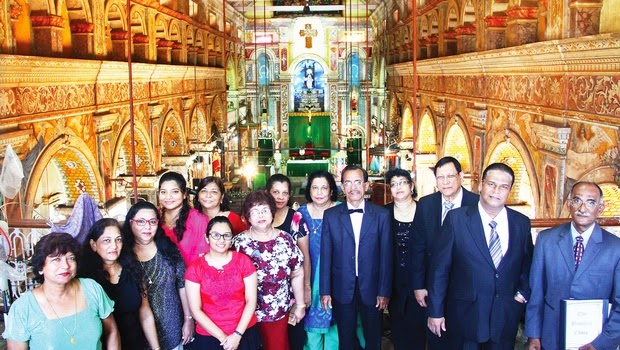
The Latin choir at the Santa Cruz Cathedral Basilica, at Fort Kochi, is one, among a few in India, which is still going strong

By Shevlin Sebastian

Photo by Mithun Vinod 

Sometime ago, the Latin choir of the Santa Cruz Cathedral Basilica in Fort Kochi was invited to sing at a wedding in a church at Coimbatore. During the mass, thechoir began to sing Handel's 'Hallelujah'. When it was over the priest, who was officiating at the wedding, in an unprecedented move, stopped the mass, and said, Could you please sing it again, because I feel like I am in the Vatican?”

At his home in Fort Kochi, on a cloudy and windy morning, the leaves creating a rustling sound among the trees in his courtyard, senior choir member Adrian Hubert (Jackie) D'Cruz, 70, breaks out into a smile. “It was an extraordinary moment,” says Jackie.

But the choir has always received appreciation, especially during the Midnight Mass at Christmas. In fact, it has become a tradition, among foreign tourists, that if you are in Kerala, on December 24, then you must attend the midnight service at the Santa Cruz Cathedral Basilica and listen to the Latin choir.

“A large number of the congregation are Europeans,” says Jackie. “After the mass is over, they congratulate us for the singing. They are surprised that we are still keeping up the Latin tradition.”

The choir, which consists of 12 singers – four men and eight women – range in age from 20 to 75. And they sing in four voices: bass, tenor, alto and soprano.

The prime force is Godwin Figueiredo, 62, who plays the organ. “He is an excellent teacher and composer, and has the gift of writing music,” says choir member Coral Godinho, who trained under Godwin, and became a tenor, like Jackie.

“There are many traditional masses in Latin,” says Godwin. “The most common is the Missa De Angelus. This is a universal mass that takes place in Catholic churches throughout the world.” Some of the hymns include Kyrie Alison (Lord of Mercy), the Credo (I Believe), Gloria In Excelsis Deo (Glory to God on High), and Pater Noster (Our Father).

The Santa Cruz group is one, among a few in India, which is still going strong. “Although most people prefer the English mass nowadays,” says Godwin. But those who listen to the Latin hymns are gripped. “There is a mystique in the music,” says church-goer Annabel Peters. “Just like when you go to the temple and hear the chants in Sanskrit, similarly, there is a power in these hymns.” Coral agrees. “There is a divinity in the songs and you can sense the presence of God,” she says.

As for the history, in 1918, a Portuguese priest, Fr. Furtado, came to Fort Kochi and trained a few young men in choral singing. They included Jackie's father, William, and his friend Dionysius Fernandez. After a couple of years Fr. Furtado returned to Portugal, and Dionysius took over. “A lot of the people who sang in thechoir at that time were his classmates,” says Jackie. “They were a good group, till Dionysius passed away in 1970.”

Suddenly, there was no leader and the choir faded away. But, in 1985, thanks to the initiative taken by a nun, the late Dr. Teresa Lonan, who was the headmistress of the St. Mary's Anglo-Indian school at Fort Kochi, as well as Tony Fernandez, a local businessman, who became the patron, the choir was revived once again, with Godwin in charge. 

“It has been going strong ever since,” says Tony.

(Sunday Magazine, The New Indian Express, South India and Delhi)

Thursday, December 18, 2014

Running Forever


Steve Boone has run 591 marathons. On a recent visit to Kochi, where he took part in the Spice Coast Marathon, along with his wife Paula, they talk about the joys of running

By Shevlin Sebastian

Photos by Mithun Vinod: Steven Boone; With his wife Paula. 

It was around the 18 km mark, during the Spice Coast Marathon at Kochi, that Steve Boone, 65, began to feel tired and dehydrated. Even though the race took place in the early morning, Steve was drenched in perspiration. He drank a lot of water, but still felt dehydrated. He began to slow down. Soon, he was walking. Many runners went past him. But the bystanders cheered him on.

It was my lack of preparation that did me in,” he says. “I came on a Friday from the United States, did not take adequate food or rest, and raced on Sunday morning. I also found it difficult to adjust to the humidity.”

The members of the organising team, Soles, poured an 18 litre bottle of water on him. Soon, they offered to drive him to the finish line. But Steve said no, and struggled on. Finally, 6 hours and 40 minutes later., Steve completed the marathon, the longest he has taken. The average time which he takes is 3 ½ hours.

The Spice Coast Marathon was an unique experience for Steve. “The people were so friendly and encouraging,” he says. “It was also the first time that I have shared the street with goats and cows.”

Steve has run in all the 50 states of the United States five times, and in Iceland, Africa, China, Germany, Brazil, and South Africa.

In the Entabini Game Reserve, in Johannesburg, there were lions, giraffes and rhinos. “We waited for the rhinos to cross the road,” says Steve. “They did look at us and wonder who we were. I am told that rhinos are vegetarians, so there was nothing to worry.”

Another run, which he enjoyed a lot, was the Nanisivik Midnight Sun Marathon
in northern Canada. “It was about 750 kms from the Artic Circle,” he says. “In July, the sun never sets. But ironically, it was quite hot.”

In most of his runs, he is accompanied by his wife Paula, whom he met at the Boston Marathon in April, 1997. They fell in love and got married in 1998. It is a second marriage for both.

Asked about the best aspect of running, both of them unanimously say, “It is the friendships that we have made all over the world. We all share the same passion.”

One of their friends is Mathew Mapram, of Kottayam origin, who lives in the US. “It was Mathew who invited us to take part in the Spice Coast Marathon,” says Steve. “And both of us will be here next year.”

In India, Steve has a clear agenda. He wants to inculcate the joy of running among the people. “You can run anywhere,” he says. “And anybody can do it. At the starting line-up, you cannot tell who is rich or poor. When you run, you tend to develop a positive attitude. For the women, it will empower them. For the children, it is good fun.”

The couple do their bit to encourage youngsters. In Houston, where they live, Steve and Paula hold running events for schoolchildren which have become very successful. In 2014, 9300 children in 24 schools ran 42 km or longer during the school year to earn a Marathon Challenge T-shirt, provided by Steve.

Incidentally, Steve came to running accidentally. He is a computer systems analyst who owns his own company. One day, a customer, Bob McDowell challenged him to run a marathon. So Steve began training for it. When he completed his first race, he was hooked onto running. Now, ironically, after 28 years Bob has only run 47 marathons, while Steve has reached marathon No. 591.

In order to ensure that Steve completes all the marathons that he participates in, he runs 75 kms a week to develop endurance and flexibility. “Then you will feel comfortable during a marathon,” he says. “The joy of running is that you can think about a lot of things, without the interruption of the phone, or e-mails. In short, nobody is bothering you.”

But you can be bothered by the weather. In a race in Delaware, there was a wind chill of minus 58 degrees below zero. “It was so cold that the water in the cups would freeze, before the volunteers could give it to us,” says Steve. “And after a few hundred metres, I received the full blast of the wind and found it difficult even to breathe.”

In Arizona, the couple ran a race in 42 degrees Celsius. “Even though the race was held in the evening, it was too hot,” says Paula. “We drank lots of water. It was pitch black. The roads were dusty. From the knee down, our legs were covered with black dust. But we finished the race and felt proud about that.” 

(Published in The New Indian Express, Kochi and Thiruvananthapuram) 

Tuesday, December 16, 2014

Talking about Art and Other Matters


At the Kochi-Muziris Biennale, a noted psychoanalyst analyses the event, senior artists view appreciatively the work of upcoming talents, while an Indian writer meets her Dutch illustrator for the first time

By Shevlin Sebastian 

Photos: Sudhir Kakar and his wife; Sirish Rao and his Canadian wife Laura Byspalko. Taken by Ratheesh Sundaram

Noted psychoanalyst Sudhir Kakar's eyes widen as he views Anish Kapoor's work, 'Descension', at the Aspinwall House, one of the sites of the Kochi-Muziris Biennale.
In a large container, buried in the ground, water is swirling around, at great speed, thanks to a submerged propeller. At the centre, it creates a vortex, which is a hypnotic sight. “It is a beautiful work,” says Sudhir, who is accompanied by his German wife Katharina Poggendorf. “But Anish, as everybody knows, is a great artist.” 
As the couple step out on to the side facing the sea, Sudhir's eyes light up. “The beautiful thing about the Kochi Biennale is how rooted it is to the earth,” he says. “The sea is also nearby.” 
Biennales in the West are like their music, says Sudhir. The rules are fixed on how to play it. “But in Indian ragas, a lot of innovation takes place,” he says. “The Kochi Biennale is like an Indian raga.”

Feeling the Heat
The hot sun is taking a toll on Paris Viswanadhan, as he wipes his forehead with his handkerchief. “It is lunch time and I am also feeling hungry,” says the Paris-based artist. His grey hair is like a halo over his head. “There are some wonderful works that I have seen so far,” he says. “I am particularly impressed with the clay works of young Sahel Rahal.”
As he talks, a friend of his comes up. He is Deepak Ananth, an art historian, who teaches at the Ecole des Beaux Arts in Caen, Normandy. “He is the first person to do an in-depth presentation of contemporary Indian art in Europe,” says Viswanadhan.
Asked his opinion about the Biennale, Deepak says, “It has been beautifully curated.”

A Happy Supporter
Another person, who agrees with Ananth, is Malayali artist Balan Nambiar. “The selection of the art works has been very good,” he says. “There is a wide variety. And today, in the international community, Indian art is being regarded as pre and post-Kochi Biennale. That’s how big an impact the Biennale has made abroad. We are lucky it is being held in Kerala. I have given unstinted support to [founders] Bose Krishnamachari and Riyas Komu from day one. So I am very happy to be here.”

A Writer meets her Illustrator
The Bangalore-based poet Mamta Sagar exclaims, “I have been searching for you all over.” And then she hugs the Dutch artist Juul Kraijer. Mamta had loved the work of Juul, which she saw on the Internet. Then she contacted Juul through e-mail, and the latter did the cover of Mamta's second book of poems in Kannada called 'Heige Haaleya Meile Haader' (‘Like this the song’). But they were meeting for the first time at the Biennale.
Juul is married to Aji V.N., an artist who was born in Thiruvananthapuram. They met when Juul came to Thiruvananthapuram, and fell in love. Now, they have a small daughter and the couple lives in Rotterdam. His daughter knows only to speak in Dutch. “But they are going to stay at my home in Thiruvananthapuram for a few weeks,” says Aji.

Acrobats doing a Balancing Act
At the Vasco Da Gama square, at Fort Kochi, on a high wire, there are fiberglass figures of colourful acrobats. One stocky male has a woman balancing her head over his, while he holds a cub tiger under his arm. He has hoofs for feet. And there are a few other men and women like this.
A couple who is fascinated by this work are the Vancouver-based Sirish Rao and his Canadian wife Laura Byspalko. They run the annual Indian Summer Festival of literature, music and films. When told the name of Gulammohammed Sheikh, as the artist who made it, Sirish says, “He is a great man. So, it's no wonder that this is a striking work.”

Endless Patience
You have to hand it to Anish Kapoor, one of the Britain's top artists, who has been knighted by Queen Elizabeth and has an estimated fortune of 100 million pounds. The shoot for an international TV channel, in the garden of Aspinwall House, takes a long time to start, because of technical glitches. But Anish keeps his cool and waits patiently for things to fall into place.
The Indian artist Subodh Gupta is walking past with his wife Bharti Kher. But when he sees Anish, he rushes up to take a snap of him on his mobile. Anish gives a friendly wave. It is difficult to visualise some of our prima donnas in the cultural world behave in a similarly calm and humble manner.

Express Special a Hit
Former Prime Minister IK Gujral’s nephew’s wife, Feroze Gujral, an art aficionado, is going gaga at the four-page special on the Biennale, brought out by The New Indian Express. “It looks lovely,” she says. “It is so nice you are doing so much to promote the arts. I am impressed.” Spanish student Elena Brunete, who has a copy, says, “It’s wonderful. The photos look good.” Another impressed person is British artist Hew Locke. “It looks nice,” he says.

(Published in The New Indian Express, Kochi and Thiruvananthapuram)

Monday, December 15, 2014

Of Body and Sole


Last year, IT Professional Ramesh Kanjilimadhom started the Soles running club, along with a few friends. Within months they had 1200 members and the group successfully conducted the Spice Coast Marathon recently

By Shevlin Sebastian

Photo: Ramesh Kanjilimadhom and members of the Soles running club. 

Photo by Ratheesh Sundaram

At 5.30 a.m. on August 10, 2012, IT professional Ramesh Kanjilimadhom set out on a run from his apartment at Kochi. It was raining heavily and there was darkness all around, except for the street lights.

Ramesh was wearing a white singlet and blue shorts and running barefoot. Suddenly, from a bylane, a car appeared. Before Ramesh could realise what was happening he had been hit on his left side and fell down. The panicky driver sped away.

When Ramesh sat up he saw that his leg was broken. “I held my leg and tried to stand up, but could not do so,” he says. A desperate Ramesh tried to wave down a few people in their cars, but nobody stopped. But, as always, there is a Good Samaritan. In this case, it was Rockey Roger, who had just finished his night shift at an IT firm and was on his way home. Rockey rushed Ramesh to a nearby hospital.

When Ramesh recounted this incident to his friends – Renjith Mohan Kumar, Thomas Paulose, Mathew Mapram, Paul Mathew, Manoj Kuriakose, and Prasanna Kumar – they urged him to start a running club. “When we run in a group, safety is a given for the individual,” says Prasanna.

Following discussions, it was Manoj Kuriakose who came up with the club's name: ‘Soles’. “What do runners run with?” says Manoj. “With our soles. It is about our souls, too.”

Ramesh’s wife, Seema, who is also a runner, says, “We felt it is important to spread the habit of running in Kerala, where so many people suffer from diabetes and other health problems.”

Soles was set up by Ramesh and his friends on June 30, 2013. And thanks to their Facebook presence, within months, they had 1200 members which included doctors, IT professionals, businessmen, journalists, homemakers, students and lawyers. There is also a labourer, Mahesh, who works on construction sites. “He always comes for the Sunday run,” says Ramesh.

This takes place at 5.30 a.m. It begins from the Kadavanthra area in Kochi, and ends up at the Jawaharlal Nehru International Stadium, a distance of 8 kms.

This is the day when beginners are initiated. “There are many who walk the distance,” says Ramesh. “I tell the newcomers they should run for five minutes, and walk for two minutes. Then run again. As a result, they will not hit a mental or physical wall, and will be able to complete the run.”

Of course, sarcastic comments by bystanders are part of the baggage. When they see me running, in shorts, sometimes they will shout, ‘Hey man, did you lose your trousers along the way?’” says Ramesh, with a smile.

Meanwhile, one day, in February, this year, Mathew Mapram came up with the idea to hold a marathon race. Mathew, who is of Kerala origin, is a veteran marathon runner in the USA. “He belongs to a large network of people who are passionate about running,” says Ramesh. “Mathew wanted to give them an experience of running in India.”

Ramesh and his co-founders felt jittery about conducting a marathon, because they had never organised one. But, thanks to Mathew's goading and encouragement, Soles held the Spice Coast Marathon on November 16. Around thousand runners took part, including several from the USA.

One of them was the silver-haired Steve Boone, 65, who has run 591 marathons all over the world. “Unlike other races, conducted by event managers, there was a lot of heart in this race, because it had been organised by the runners themselves,” says Steve. “The people were friendly and nice. I enjoyed every moment.” For Ramesh, the most thrilling moment occurred, when, runners at the finishing tape, shook his hand, and said, “Great race.” 

Indeed, the unique nature of this particular marathon (42 kms) was the 42 heritage sites which the runners had to pass by. These included the Cochin Port Trust, Mattancherry bridge, Jewish Synagogue, Jew Town, Dutch Palace, Spice Market and the Parade ground. “We will be holding the marathon again the next year,” says an upbeat Ramesh. “Soles is here to stay.” 

(Published in the Sunday Magazine, The New Indian Express, South India and Delhi)