StatCounter

http://statcounter.com/p4130240/summary/?guest=1

Monday, April 10, 2017

The World Is Beckoning


Vishnu Raj S Menon, the first Malayali to win the Mr India title, is gearing up to make a mark in the Mr. World contest

Pics: Albin Mathew 

By Shevlin Sebastian

Moments before the winner of the Mr India 2016 contest was announced by Bollywood superstar Hrithik Roshan, at Mumbai, on November 23, Vishnu Raj S Menon, who was standing in the last row, of the 16 participants, closed his eyes and prayed fervently to his favourite god: Lord Vishnu. And then the magic happened. “Vishnu Raj” said Hrithik. And a stunned Vishnu made his way to the front.

The first thought that came to my mind was that now I had to represent India at the Mr. World competition,” says Vishnu, who became the first Malayali to win the coveted title. And when Vishnu shook Hrithik's hand, the latter said, “I can see, in your eyes, the hard work that you have put in. You deserve the win.”

It was a fairy tale for Vishnu. Because just three years ago, Vishnu met with a bike accident in Thrissur. His thigh bone was dislocated and Vishnu was not able to walk for three months. “In the end, I was bed-ridden for six months,” he says. At that time,Vishnu was doing his first-year civil engineering course from the M.V. J. College of Engineering at Bengaluru. Anyway, once Vishnu recovered, he returned to his college.

Vishnu's turning point came when he took part in the 'Models Unlimited' contest in Bengaluru in October, last year, and came under the guidance of Prasad Bidapa, the well-known fashion stylist and choreographer. “Prasad Sir taught me the basics of how to walk on the ramp, look good and radiate confidence,” says Vishnu. “He also spoke about the importance of mental strength.”

For the Mr. India contest, Vishnu lifted weights, and did endurance running. He was also on a strict diet, where he ate mostly egg whites and drank green tea. As a result, the 6' tall Vishnu weighed 82 kgs, and displayed rippling chest and thigh muscles, apart from a six-pack.

In the 'Mr. Active' round, Vishnu did 50 push-ups, sit-ups, and burpees each, ran 20 laps of a 400 m track, carried a 40 kgs sandbag on his shoulders and pushed a large tyre for 100 metres. In the end Vishnu came in the top six. But in the photogenic round, Vishnu emerged in the first place.

But all that is in the past. Now Vishnu is training hard for the biennial Mr. World title, which will take place at London, in July, 2018. For that he has already received words of advice from Rohit Khandelwal, the reigning Mr. World. “At present, I am doing a lot of cardiovascular training, apart from lifting weights,” says Vishnu. He is also taking personality development courses, dance as well as acting classes.

Contestants from more than 40 countries will take part. “With self-confidence, hard work and a strong will, I think I can win Mr. World,” says Vishnu, who will be the first Malayali to take part in this international pageant. 

(Sunday Magazine, The New Indian Express, South India and Delhi)


Tuesday, April 04, 2017

The Rasas Of Cooking


Chef Ranveer Brar talks about the charms of Kerala cuisine and the recipe for success

By Shevlin Sebastian

At a convention centre in Willingdon Island, Kochi, Chef Ranveer Brar puts chocolate cream, butter, sugar, and caramelised orange juice into risotto rice mixed with milk. Then he stirs the mixture, heats it up, adds leaves of mint, and then offers it to the people present. The resulting taste is simple and delicious.

Risotto is an Italian dish, but they don’t make it sweet,” says Ranveer. “It is more a savoury, like mushroom risotto. But I decided to make something new.”

Ranveer had been specially invited by Mercedes Benz for their customer engagement initiative called Luxe Drive.

But this is not the first time that Ranveer has come to Kerala. Eleven years ago, he had come for a friend’s wedding and became enamoured of Kerala cuisine. “I loved the avial I ate at the function,” he says.  

Thereafter, he started studying Mappila food, Syrian Christian recipes and the menu of the Nampoothiri Brahmins. “The fascinating part about Kerala cuisine is the way it changes across regions,” he says.  

And he lists his favourites. “The biriyani that the Mappilas make is awesome,” says Ranveer. “It is not refined and sophisticated. Instead, it is rustic but tasty. Similarly, the practice of sadhya was started by the Nampoothiris as a way to feed the Brahmins. I also enjoy the Syrian Christian fish curry but this is something I would like to have the next day, because it tastes good only after a day of fermentation.”

Asked to compare Kerala cuisine with other parts of India, Ranveer says, “It cannot be compared, because for 2000 years there have been so many influences: the Romans, Arabs, Dutch, Portuguese, and British. It is a unique cuisine.”

And thanks to his Global Menu television show, on the Foodz channel, Ranveer is always coming across unique cuisines. “The show goes off the beaten track and has focused on places like North and South Korea, Sri Lanka, Romania and Mongolia,” he says.

The Mongolians have a dish called Khorkhog. Chicken or lamb is cooked with vegetables and stones in a closed container. “When you eat it, you can detect a slight earthiness from the stones, which makes it very tasty,” says Ranveer.

Apart from his TV show, Ranveer runs restaurants in the USA, Canada and India. Last year, he brought out a cookbook called ‘Come into my kitchen’. His Mumbai-based premium patisserie, ‘English Vinglish’ serves fusion desserts, breads and bakes. Ranveer has done a mini-video series on Twitter titled ‘Ranveer On The Road’, which featured his culinary sojourn through Australia, apart from being a judge on Season 4 of Masterchef India.

And this passion for food began in the unlikeliest of places. When he was a child, growing up in Lucknow, his grandfather Jagir Singh would take him to the gurudwara. A restless Ranveer would run around and end up at the langar. “That was when I saw cooking for the first time,” he says. Soon, Ranveer began helping around.   

At age 16, he did the unthinkable for a son of an aeronautical engineer. He ran away from home and worked at a roadside kebab shop run by a man called Munir Ahmed for eight months. However, later, he graduated from the Indian Institute of Hotel Management at Lucknow.  

Asked the secret to a good dish, Ranveer says, “Our five fingers have five rasas: sweet, sour, salty, savoury and spicy. So, when we cook with the hand, the rasas go into the food. And when we eat with our hand, the rasas go inside us. It is important to cook honestly and sincerely because food transfers emotions. So, you are always giving a part of yourself in every dish.” 

(The New Indian Express, Kochi and Thiruvananthapuram)

Monday, April 03, 2017

Making Children Smile


The Heyyo Media group, through their 'My Classroom Campaign', is brightening up classrooms, all over India, with colourful art on the walls

Photos: Students of the St. Ignatius Lower Primary school at Kochi, along with the Heyyo Media group members; (From left): Jayakrishnan G. Pillai, Founder-Director of Heyyo Media, Creative Head PA Sreejith and Sumi Thomas, Content Head. Pics by Albin Mathew  

By Shevlin Sebastian

During the lunch-break, on most days, seven-year-olds Prijith P and Abhirami Rajesh would rush to stand against the wall of their classroom at the St. Ignatius Lower Primary school at Kochi. There is an illustration of a smiling giraffe holding a baby monkey. Beside it is a scale to measure the height. Prijith looks at Abhirami and says, “I am taller.” Abhirami shakes her head and says, “No, I am.”

Their class teacher Sheeja Raju smiles indulgently. “They do this nearly every afternoon,” she says. “All the children now enjoy coming to school.”

The transformation happened a couple of months ago. Members of the Heyyo Media, an interactive agency, transformed the drab walls, with more than 60 illustrations. These include drawings of houses, a monkey reclining on the branch of a tree, a smiling dragon, various types of fishes and octopuses, as well as maps of Kerala and India.

On a recent morning, nine-year-old Nasir Ali leads a visitor to his favourite illustration: it is the Aesop’s Fable, of a thirsty crow trying to fill a pitcher, which has very little water, with pebbles, to raise the water level.

Thanks to these illustrations, teaching has become easier,” says Headmistress MG Sindhu. The classes, in one large hall, comprise students from Class 1 to 4. “They are the children of labourers,” says Sindhu. “There is also a colony nearby where a lot of Maharastrians live. Their parents and grandparents have studied here. So, they continue to send their children to our school.”

Asked why they took the initiative, Jayakrishnan G. Pillai, Founder-Director, says, “At Heyyo, we believe in giving back to society. But we wanted to do something creative. My team and, particularly, [Creative Head] PA Sreejith, who is an artist, can draw well. We began discussing the possibilities regarding art and schools, and changing lives. Then a colleague Joffy V Cyriac said, 'Why don't we paint a classroom?' And that was how we began the 'My Classroom Campaign'.”

Meanwhile, the Campaign has begun to spread its wings. On December 15, last year, they were at the 'City of Los Angeles' school in Matunga, Mumbai. But when they first walked in, and tried to take off some posters, they got a shock: the cement came off. “We could see the brick layer underneath,” says Sreejith. “We realised that we had to do a lot more.”

So, three layers of primer were applied. “Fortunately Shalimar Paints came forward and provided all the material that was required,” says Content Head Sumi Thomas.

In February, the members travelled to Noida, where they painted a classroom for the NGO, My Perch. “In March, we worked on nine classrooms in two schools, Government Lower Primary School, Puthuvype, Kochi, and Kumar Shala in Vapi, Gujarat,” says Pillai. “In 2017, our aim is to do 50 classrooms across the country.” 

(Sunday Magazine, The New Indian Express, South India and Delhi) 

Friday, March 31, 2017

The World Of Consciousness


In his book, Radhakrishnan Panicker delves on spirituality and science

Illustration by Amit Bandre

By Shevlin Sebastian

Three-year-old Swarnalatha Mishra was travelling in a vehicle with her father in Madhya Pradesh. About 180 kms from her home, in a town called Katni, she asked the driver to go down another road towards her 'home'.

Her father was puzzled. She then described the house: it was white in colour and had black doors. There were four rooms on the ground floor. There was a railway line in front and a girl's school at the back. The family also owned a motor car.

And they stopped at a house in the exact description given by Swarnalatha. When Prof. HN Banerjee, the head of parapsychology at the University of Rajasthan, came to know about this, he interviewed Swarnalatha and confirmed all what she said.

Swarnalatha said that she was Biya Pathak in her previous life. This was confirmed by the family members who said that Biya had died in 1939, leaving behind a husband, Chintamini Pandey, and two sons.

Later, when Chintamini met Swarnalatha, in 1948, she accurately told him many details of their married life including an amount of Rs 1200 that she put in a small box, which was taken away by Chintamini.

This anecdote has been recounted in the book, 'Convergence – Ultra Science and Vedic Spirituality' written by Radhakrishnan Panicker, a Kochi-based retired teacher who has worked in India, Africa, USA and UK.

I had studied 20 cases of soul reincarnation,” says Radhakrishnan. “Reincarnation is a fact of human existence. Suppose, I am a murderer. When I reincarnate I might come back as a victim. This is how karmic effects are neutralised.”

Radhakrishnan has covered a wide range on the subject of science and spirituality in his 282 page book, published by Notion Press. These include the superstring theory, primordial vibrations, electronic voice phenomena, consciousness, yoga sutra, and the quantum theory.

Asked about the existence of God, he says, “There is a God field. It is a power beyond the ordinary. It encompasses the whole existence. To realise God you have to reach that field. But your brain has got adapted to the visible world. So, it is not easy. That is why spiritual masters recommend meditation, yoga and mantras in order to access the internal energy field.” ”

There are all types of energies. “There is the energy in the visible world – atoms, photons, graviton, electrons, the earth, galaxies, solar system and the universe,” says Radhakrishnan. “There is also an existence beyond the visible world. As for what it is, the answer comes from the Vedas. It is satchidanandan or the universal consciousness.”

One of the subjects Radhakrishnan explores is Extra Sensory Perception (ESP). “Ingo Swann, an American medium, was told to visualise Russian military installations, through ESP, because the spy satellites could not get any photographs,” says Radhakrishnan. “Ingo concentrated and drew what he saw. Later, it turned out to be accurate. The American government released a report in 1995 stating that a man can leave his body provided that there is enough energy to do so. Through my research I realized that this energy is divine.”

Ingo wrote a book, called 'Kiss The Earth Goodbye', in which he asserted that a man can leave the earth through an out-of-body experience. “Like reincarnation, ESP is also an undeniable fact of human existence,” says Radhakrishnan.

Asked about his final conclusions, Radhakrishnan says, “We are immortal, in the sense that we willcontinue to exist long after we die. There is an immortal energy field within all of us.” 

(The New Indian Express, Kochi and Thiruvananthapuram)

A Feast Of Art


As the Kochi Muziris Biennale came to an end, on March 29, visitors, stakeholders, and participants give their impressions

Photos: Pavneet Pal Singh; Rahul Nair and Meenakshi Soman, Isi and Zehavit Orlev and Jineesh, NA, the owner of the Al-Hala restaurant

By Shevlin Sebastian

Confidence-enhancing

Architect Pavneet Pal Singh, 25, was at a loose end in Chandigarh. That was when a friend said that there were openings as volunteer/guides at the Kochi Muziris Biennale. He applied and was selected. Three months later, he has a joyous smile on his face. “I am enjoying my stint,” he says.

His job is to take people on guided tours. Every day, there are two public tours, lasting 90 minutes, at 11 a.m. and 3 p.m. The crowd is a mixed bunch of foreigners and Indians. Apart from that, he gets assigned to important guests like diplomats, politicians, film and cultural celebrities. 

Without realising it, there have been gains for Pavneet. “My public-speaking skills has 
improved a lot, and I have learnt to deal with all types of people,” he says. But, mostly, 
the visitors have reacted gratefully. “That is because contemporary art can be difficult to 
understand so they need help,” says Pavneet. 
Not surprisingly, Pavneet is keen to take part in the next edition but, as he says, Preferably,
in some other role.” Finally, when asked about the art work which created the most
impact on people, Pavneet says, “Raul Zurita's 'Sea of Pain'.” At that installation, you
walk across a foot-high sheet of water, inside a room at Aspinwall House. This is a poetic
metaphor about illegal migrants trying to cross over to Europe from Africa on rickety boats
through the Mediterranean Sea and losing their lives in the process.
Young and Creative 

Walking swiftly through the grounds of Aspinwall House are Rahul Nair and Meenakshi 
Soman, independent writers and documentary film-makers. For the Surat-based Rahul, this is 
his second visit. “I had come earlier in December,” he says. “But when I heard that the 
Biennale is ending on March 29, I decided to come again because I had not seen all the works. 
And it has been great so far.” 

So excited was Rahul that, after his first visit, he informed his friends, While a few took flights,
several took the 32-hour train journey from Surat to come to the Biennale over the past three months.
For the Kochi-based Meenakshi, she has come often. “The best time is in the morning, just
when it opens,” she says. “There are hardly any visitors and I enjoy walking around. Since the
works are so amazing, it has been a creative stimulant for me.”
Like, in the case of Rahul, Meenakshi's many friends from places like Pune and Mumbai
made he journey to see the Biennale. “They all liked it,” she says. “But they all agreed that
one day is not enough. You need to spend at least two to three days to see all the works.”
From Israel with love

Isi and Zehavit Orlev, pensioners from Tel Aviv, Israel, were relaxing on the Marari beach 
at Allapuzha when they met Orna Lutski, a well-known Israeli artist. “When she heard that we were going to stay at Fort Kochi for a couple of days, she urged us not to miss the Biennale,” says Orna. “That is why we are here.”

Both of them enjoyed the Orijit Sen 'Going Playces' interactive art exhibition. “I saw a few drawings that reminded me of the paintings of [Russian-French artist] Marc Chagall,” says Isi. “We have liked what we have seen. It is good that a major festival is taking place in Fort Kochi, although both of us are finding it difficult to adjust to the heat and the humidity.”

Feeding the Crowds

It is evening. And Jineesh, NA, the owner of the Al-Hala restaurant, just near Aspinwal House is sitting on the steps and having a chat with his friends. Thanks to the location, he has done very good business because of the Biennale. “Many visitors have come to my shop,” he says. “The customers included both North Indians and foreigners.”

The favourite order was biriyani: chicken, prawn, fish and chicken. People also ordered Chinese and fish dishes. “Our business grew by 35 per cent because of the Biennale,” he says. “In fact, everybody has gained, like the hotels, homestays, small shops and autorickshaw drivers. It has been good for business. So I will feel a bit sad that the event ended on March 29.” 

(The New Indian Express, Kochi)

Wednesday, March 29, 2017

“The Biennale Is A Large Cultural Movement”

Riyas Komu, the Co-Founder of the Kochi Muziris Bienalle reflects about the third edition

By Shevlin Sebastian

One of the unusual experiences, for Riyas Komu, the Co-Founder of the Kochi Muziris Bienalle, at this year's edition, has been to watch people as they enter the ‘The Pyramid Of Exiled Poets’ by Slovenian artist AleÅ¡ Å teger’. It is dark inside the installation. And on the walls, through speakers, you can hear the anguished voices of poets like Bertolt Brecht, CzesÅ‚aw MiÅ‚osz, Mahmoud Darwish, and Joseph Brodsky.
  
Many visitors felt so uncomfortable that they would rush back out through the entrance itself,” says Riyas. “This work takes you into dark realities. It is almost like a memorial to the time, because poets, as well as liberal voices, are being suppressed all over the world.”

It is a warm Wednesday evening at Aspinwall House, Fort Kochi. And Riyas is in a relaxed mood. Wearing a purple shirt and Bermuda shorts, he had just concluded an interaction with noted Bollywood film director Vidhu Vinod Chopra.

As he stands next to a buggy, a young couple ask him whether they can use it, to go to other venues. Riyas agrees but, unfortunately, the driver has gone out for a cup of tea. 

As the couple move away, Riyas ruminates on the impact of this year's edition. “Many people had come with the mind-set of the Bienalle being a spectacle, and of looking at a work and understanding the story,” he says. “But this Biennale [curated by artist Sudarshan Shetty] has been different. It is asking many questions and has made people puzzled. Nevertheless, there are many art works which are pulling people in.”

For Riyas, the most stunning has been the 'work in progress' by mural artist PK Sadanandan. “He has engaged with a contemporary art project with a great mind of a traditionalist,” says Riyas. “Sadanandan broke all the rules of the Kerala mural art tradition in the way the work is laid out. Normally, the images are very flat, but his is three-dimensional.”

For most artists, it is difficult to do their creative work in front of the public. But Sadanandan has allowed visitors to see how the colours are formed and filled in, and how the brushes are made. Despite thousands of people walking past, he is able to concentrate on his work.

That is because he is a master,” says Riyas. “It reminds you of the time [in the 15th century] when great artistes like Michealangelo and Leonardo Da Vinci made art in front of the public. And he is narrating a story, with so much contemporary relevance ('Parayi Petta Panthiru Kulam', a Kerala legend, of the 12 kulams – families born to the Parayi, or women of the 'pariah' caste). Sadanandan's work will remain as one of my great memories of this Biennale.”

Another aspect, which is new to this edition, has been that many artistes, curators, museum directors and academicians from all across the world had come to see the Biennale. “It is an event that can no longer be missed,” says Riyas. “Artistes like Ali Steger and Raul Zurita have not shown in Bienalles before. We have introduced many different dimensions to art-making. So far, in the past six years, we have produced more than 250 projects.”

As for the future, Riyas says, “The Biennale is now a large cultural movement led by the people. We [Bose Krishnamachari and himself] were just the catalysts to make it happen. I am sure the future is bright.”

(The New Indian Express, Kochi) 

Tuesday, March 28, 2017

An Upside-Down World

Affected by Hurricane Sandy, which hit New York in 2012, American artist Tom Burckhardt recreates a flooded studio, in a unique way, at the Kochi Muziris Biennale
Photo by Albin Mathew
By Shevlin Sebastian
When you step in to see the American artist Tom Burckhardt’s cardboard installation, at the Kochi Muziris Biennale, you experience a sense of disorientation. The reason: everything is upside down.
So, paint cans on shelves are pointed towards the floor, there are black monochrome paintings which are also upside-down, some books, like Leo Tolstoy's 'War and Peace' and Fyodor Dostoyevsky's 'Notes from the Underground', defy gravity, while a couple of canvases are stuck on the ceiling.
Titled, ‘Studio Flood’, the work was, indeed, inspired by a flood. On October 29, 2012, Hurricane Sandy hit New York with destructive force. “There was five feet of water inside many houses and artists’ studios,” says Tom. “Some artists, who had basement studios, lost their entire work.”
This was also the situation at the art gallery district called Chelsea, which is close to the shore. “The image of all the art works floating in the water stayed in my mind, apart from all the wasted effort,” says Tom. “The only good that came out of it was that artists, normally so self-centred, came together and helped one another.”
Asked whether his installation is an exact replica of a studio in New York, he says, “There is a bit of Kochi, too.”
That is true. When you look through the window, you can see palm trees. On one wall, there is Kerala-style political graffiti, with the familiar hammer and sickle, the symbol of the Communist Party.
Like in the US, flooding is a big issue in coastal Kochi as well as Kerala, owing to global warming. “So I believe there is a link between New York and Kochi,” he says.
Tom also believes his work is an apt metaphor. “When a tragedy hits people they will always say, 'My world has turned upside-down',” he says.
Initially, when Tom arrived in Kochi, he did find his world go upside-down. That’s because he could not find the right type of cardboard to make the installation for several days. When Biennale founder Bose Krishnamachari came to know, he made a call. Within a day, the correct material arrived. “It gives you an indication of Bose's clout,” he says.
Asked why he used cardboard, Tom says, “People can relate to it, unlike oil and acrylic.” The other materials he used were black paint and glue.
As for his impressions about the Kochi Biennale, Tom says, “This is a very organic festival. It is based on an artistic vision and not so much a curator or a theorist's vision, and I tend to be uncomfortable with the latter.”
There are other charms, too. “The setting is unique,” he says. “I love it that this festival is for everybody in this town. In other Biennales, art seems to belong to the rich and the cognoscenti.”
(Sunday Magazine, The New Indian Express, South India and Delhi)

Friday, March 24, 2017

“The Art Works Are Fascinating”


Noted Bollywood film director Vidhu Vinod Chopra talks about his experiences in the Kochi Muziris Biennale, as well as his upcoming film

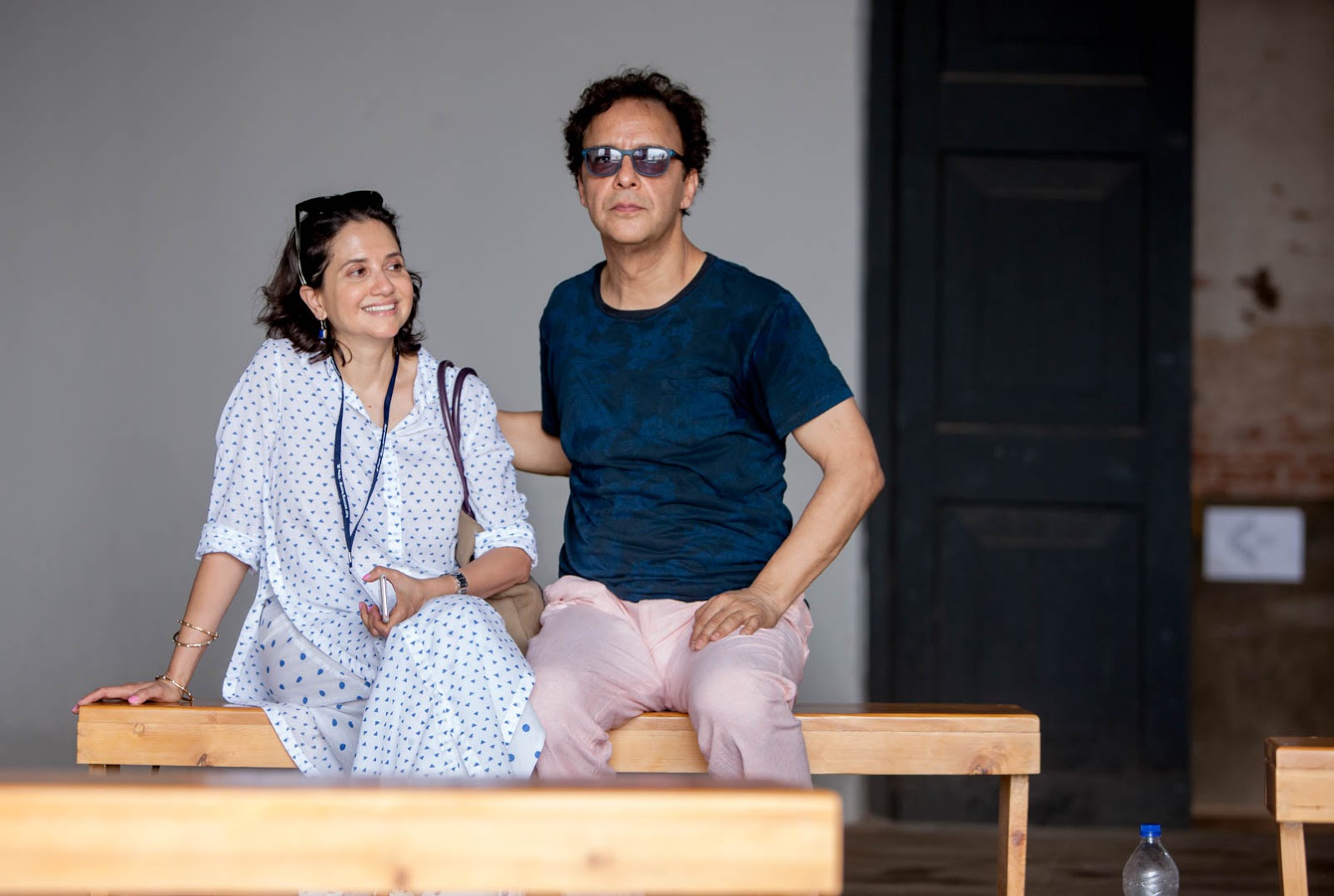
Photos: Vidhu Vinod Chopra with wife Anupama; Vidhu at the art installation by Orijit Sen

By Shevlin Sebastian

Bollywood director Vidhu Vinod Chopra breaks out into a smile as he looks into a telescope on a first floor sea-facing balcony at Aspinwall House, Fort Kochi. This is an installation work of the French artist Francois Mazabraud. “Nice, he says. His wife Anupama, a noted film critic, also breaks into a smile.

This is my first visit to the Biennale,” says Vidhu, who is clad casually in a blue T-shirt and cotton trousers. “I am obsessed with cinema, so coming here is a liberation for me. I am enjoying an art form which is outside of cinema. And the works I have seen so far have been fascinating. What adds to the charm is the beautiful ambience of Fort Kochi.”

Both Vidhu and Anupama are a playful couple. At the ‘Going Playces’ exhibition of artist Orijit Sen, they took up the challenge of placing pieces with magnet ends into the ‘From Punjab with love’ painting. “Wow, this is cool,” says Vidhu, as he places a piece in the correct slot. Later, both take up a similar challenge in the Charminar exhibit.

Meanwhile, on the career front, Vidhu is putting the finishing touches to his script of his next movie. The theme: the exodus of Kashmiri Pandits, from the 1980s to the present time.

This theme is not a surprise. Vidhu was born and brought up in Srinagar. “Kashmir is very close to my heart,” he says. “The movie is going to be an epic.” The shooting will begin in September. And the locations will be in different parts of Kashmir.

When asked if it is safe, Vidhu says, “I go to Kashmir every year. It is as risky as anywhere else in the world. Maybe, because of terrorist attacks. Paris may be more risky now. Tell me which place is not risky today? That is the world we are living in now.”

He has not selected the cast, as yet. But he is hoping to release it sometime next year. “I don’t worry about the release date,” says the maker of hits like ‘1942: A Love Story’ and ‘Parineeta’. “The film will somehow make its way into the world.” 

(The New Indian Express, Kochi and Thiruvananthapuram)

Thursday, March 23, 2017

Shooting On The 27th Floor


COLUMN: LOCATION DIARY

Director Lijo Jose Pellissery talks about his experiences on the films, 'Angamaly Diaries', 'Amen' and 'Double Barrel'

Photos: Lijo Jose Pellissery; the posters of 'Angamaly Diaries' and 'Amen'

By Shevlin Sebastian

On a windy day in January, director Lijo Jose Pellissery, cinematographer Girish Ganghadaran, a few crew members, as well as the hero of 'Angamaly Diaries' Antony Varghese were standing on the 27th floor of a building in Bahrain. Next to the building was a tower crane.

In the film, Vincent Pepe, played by Antony, following his marriage to Lichi (Reshma Rajan), in Angamaly, was working as a tower crane operator in a construction company at Bahrain.

We wanted to use a drone, and show Antony sitting in the cabin of the crane,” says Lijo. “It was a sunset scene.”

However, what came as a shock, was that there was no lift to enter the cabin. “So, we did not know how Antony was going to enter the cabin,” says Lijo. In the end, Anthony had to hold onto the side of the crane, on the 27th floor, and carefully make his way to the cabin.

At that height, there was a strong breeze blowing. “But Antony was brave, although it was a risky thing to do,” says Lijo. “In the end, it turned out to be a brilliant and realistic shot. In fact, it was the last scene of the film.”

There were many realistic scenes in 'Angamaly Diaries'. At the start of the film, a group of actors, in fancy dress, looking like Jesus Christ, a nun, and a solider were having drinks. The soldier, Paripp Marti, was played by actor Sreekanth Dasan. Soon, there was a skirmish with an opposing group and the two groups rushed down the steps of the first-floor bar.

In the melee, Sreekanth got his nose dislocated,” says Lijo. “We had to rush him to the hospital. It took him four days to recover.”

There were several fight sequences in the film. As a result, there were quite a few injuries. “This happened so often, that the nurses and doctors asked us, half-jokingly, whether it was actually a cinema shoot that was going on,” says Lijo with a smile. “But the actors were all dedicated to making a true-to-life movie.”

This dedication could also be seen in Lijo's earlier blockbuster, 'Amen'. In a scene, on a narrow bridge, there was a confrontation between Solomon (Fahadh Faasil) and his love interest Shoshanna (Swati Reddy), with the local Catholic priest's assistant Kochuousep (played by Sunil Sukhada) standing in the middle.

As Shoshanna accused Solomon of wanting to abandon her, because of his plans to become a priest, Kochuousep tried to persuade the girl to forget about Solomon. But so incensed was Shoshanna that she pushed Kochuousep away. And Kochuousep fell from a height into the water. “It was not very clean water,” says Lijo. “But Sunil unhesitatingly jumped. That showed his dedication.”

But sometimes, this dedication can be risky, too. In Lijo's 'Double Barrel', he wanted to shoot a fight sequence between two gangs using a helicam. The location was on a hill in Goa. At one side was the famous Vagathor beach. For some reason, the helicam signal was not working. So, the operators were running after the helicam, with their remote, to get the signal working.

Without realising it, they had reached the edge of the hill,” says Lijo. “At the last moment, our crew members managed to hold on to them before they slipped over the edge. I have never forgotten how close they were to falling off.”

Thankfully, the signal soon started working and they were able to shoot the scene. “For everything to work well, on a shoot, you need a large dose of luck,” says Lijo. 

(The New Indian Express, Kochi, Kozhikode and Thiruvananthapuram)

Wednesday, March 22, 2017

In Praise Of The Almighty


Sufi singer Ashraf Hydroz, who performed recently at the Kochi Muziris Biennale, talks about the art form
 
Photos of Ashraf Hydroz by K. Shijith; Amir Khusrow

By Shevlin Sebastian
 
As Sufi singer Ashraf Hydroz begins his concert at the Cabral Yard, Fort Kochi, during the Kochi Muziris Biennale, he tells the audience, “The first composition is called a Hamd. It is a song in praise of God. This is always a tradition in Sufi music.”
 
Surrounded by members of the Khayal-e-Qawwali band, who play instruments like the harmonium, tabla, dholak, the bulbul tarang and the keyboard, Ashraf starts with the invocation, 'Allahu Akbar' [God Is Great].
 
Then as the music rolls on, he sings, in Urdu:
 
Every beginning is in your name,
When the life on earth becomes extinct, that is also in your name.
You are the Master of the Entire Universe, O Allah
When there was no earth,
When there was no sky.
When there was no sun,
When there was no moon
When there was nothing
But, at that time,
You were there.”
 
Sufi music is like Hindu bhakti music. “In both, the singers are trying to evoke the Almighty,” says Ashraf. “There are also songs in praise of saints like Khwaja Moinuddin Chishti and Khwaja Nizamuddin Auliya.”
 
For Ashraf, the singing has a spiritual component. “Sometimes I forget where I am,” he says. “Often I have felt that I am a vessel of the Almighty. But in daily life, I am just an ordinary person.”
 
This 'ordinary person' was a manager of Lakshmivilas Bank till he retired five years ago. “To make ends meet, I had to do a job,” he says. “But I always kept doing public performances, usually on the weekends.”

Interestingly, the majority of the songs that Ashraf sings have been composed by Amir Khusrow (1253-1325), who is regarded as the father of the 'Qawwali'. “He has composed thousands of spiritual songs in Urdu, Brajabasha, Poorvi and Farsi,” says Ashraf. The singer also sings the romantic songs of the musical genius. “In one song Khusrow had said, 'At the sight of the beloved, I lose all my control, because of my love for her’.”
 
Ashraf also sings songs of other religions. During a performance at the Ernakulam Karayogam, in 2015, he sang Hindu shlokas and Vedic chants. “The audience was very surprised,” says Ashraf, who is a senior disciple of renowned Hindustani musician Ustad Faiyaz Khan. “They were expecting only Sufi songs. I believe that the songs, of every religion lead one to the same Universal Energy and Love.”
 
In fact, thanks to this multi-religious capability, Ashraf has been invited to give a two-hour performance at the Madhuvanam Ashram on the Maha Samadhi day of Sri Sathya Sai Baba at Thiruvananthapuram on March 28.
 
Meanwhile, Ashraf's interest in Sufi music was sparked, when, as a M. Phil student of music at Delhi University, in 1988, he went for a Qawwali concert of the famous Sabri Brothers of Pakistan, along with Indian singer Ustad Jaffar Hussain Khan. The brothers were the first to use the word, 'Allah' repeatedly during their songs. “They gave a wonderful performance,” says Ashraf. “It was then that I decided to become a Sufi singer.”
 
Whenever he had leisure time, Ashraf would spend time at the holy shrines of Khwaja Moinuddin Chishti at Ajmer, the dargah of Hazrath Nizamuddin Auliya in Delhi, the Salim Chisti Tomb at Fathepur Sikri and the Makhdum Ali Mahimi shrine in Mahim, Mumbai. 

I would sit with the Sufi singers and listen to them,” he says. “After a while, I started singing along with them. And that was how I ended up as a singer.” Today, he has performed hundreds of concerts all over India and abroad, too.
 
The Bangalore-based Ashraf pauses and says, “In these polarised times, music helps to bring people together.” 

(The New Indian Express, Kochi, Kozhikode and Thiruvananthapuram)