StatCounter

http://statcounter.com/p4130240/summary/?guest=1

Tuesday, August 16, 2011

Protect your mom, please

The Dubai-based Premi Mathew has launched a campaign on Facebook, 'Protect Your Mom', asking children to pester their mothers to have a self-examination for breast cancer every week. Early detection can lead to a cure, she says.

By Shevlin Sebastian

One day, Dr. James George (name changed), who works in a hospital in Dubai noticed a lump on his wife's breast. A mammogram followed and Shirley was diagnosed with Stage 2 breast cancer. It was a shock for her. Months of chemotherapy and radiation followed. Her beautiful flowing shoulder-length black hair vanished, as did her eyelashes. She lost her job in a multi-national as a sales manager, and fell into a deep depression.

A year later, Shirley has recovered, although one breast had to be cut away. She wears a wig, since her hair has not grown sufficiently. And she has to go for check-ups every three months. When Premi Mathew saw first-hand what had happened to her friend, she decided to do something about it.

On October 2, 2010, she launched a 'Protect Your Mom' campaign on Facebook, from Dubai. With the help of her daughter, who is studying at the Rajagiri School of Engineering, at Kochi, she got 300 members within two days. Then Premi launched a SMS campaign: 'Cancer kills and early detection is the key. Join 'Protect your Mom Campaign' on Facebook. Let us save a few lives.' Thankfully, the message was highlighted in the media in Dubai and the campaign picked up speed.

The idea is simple. Children should pester their moms to do a self-examination once a week. Premi encourages this, because a mammogram is controversial, because of the danger of radiation.

A woman should inspect both breasts to see if there are any lumps or a discharge from the nipples, puckering, dimpling, or scaling of the skin. Special attention should be given to the area from the breast to the armpit and the armpit also.

“I am sure this way we can save lives,” says Premi. “You can get breast cancer, at any time, after the age of 20. And it may not be hereditary.”

On a brief holiday in Kochi, where her parents stay, Premi wants to create an awareness of breast cancer in Kerala. She is going to schools and colleges, urging youngsters to join her Facebook campaign. “I would request principals and teachers to encourage their students to join our group,” she says.

Worldwide, one out of eight women is susceptible to breast cancer. “Early detection is very important, because cancer treatment is prohibitively expensive,” she says. “Your family finances can get wiped out.” In Kochi, one chemotherapy session in a good hospital can cost Rs 65,000.

Meanwhile, Julie, a breast cancer survivor, addressed the scourge in a letter, on Premi’s Facebook page, and it epitomises what ‘Protect your Mum’ is trying to do:

Dear Breast Cancer,
We always knew you were out there.
Wreaking havoc in people’s lives.
You came into our lives at our weakest point.
We fought you!
Here’s a news flash for you:
You caught us off guard.
It won’t happen again.
Our new life’s mission is to ensure you can’t do the same to others.
We will educate as many women as we can to eradicate you!
Watch your back! We are coming for you!

(The New Indian Express, Kochi)


Saturday, August 13, 2011

A tryst with tinseltown

For the past 30 years, Pradeep Gopalan has been pasting cinema posters on walls and lampposts in Kochi and all over Kerala

By Shevlin Sebastian

On a weekday morning, Pradeep Gopalan stands near a wall in Padivattom. From a bag, he takes out a large 'Salt and Pepper' poster, which announces that the film has completed 35 days. He flips it over, scoops up glue with his hands, from a small container, and rubs the edges on all four sides. Then he pastes it neatly on the wall.

“At Padivattom, I was coming to the end of my work,” he says. Pradeep's work had begun the previous night. He had travelled all over Kalamaserry, Kakkanad and Padivattom, pasting posters on walls and lamp posts. “If the wall is easily accessible, it takes me about ten minutes to put up a poster,” says Pradeep, who hires an auto-rickshaw to move around.

But there are places, in Kalamaserry, beside a pond, on slushy ground, when he takes a longer time. “Of course, it is much more difficult during the monsoon season, but at the same time, because of the cool weather, I feel less tired,” he says. In summer, the humidity gets to him and Pradeep becomes tired when morning arrives. “I am not getting any younger,” says the 54-year-old.

When he was 19, Pradeep secured a job as a peon in the office of a cinema in Chalakudy. Soon, he was given the job of pasting posters in the town. “Later, I would travel from Kasaragod to Kanyakumari putting up posters all over the place,” he says. “Film producers would provide a van for the job.” In eight days, he would paste 15,000 posters. And he would sleep in cinema theatres along the way.

“In those days, I would be paid Rs 2 per poster,” he says. But over the years the rates have not gone up much. “I am getting Rs 2.15 per poster now,” he says. But Pradeep has to pay for the transport charges as well as the cost of buying the raw materials, to make the glue.

In the backyard of Pradeep’s house, near the Jawaharlal Nehru stadium at Kaloor, a container has been placed on a mud stove. It contains a milky white liquid. Pradeep is making the glue.

“It has a mix of flour, water, and a chemical powder,” he says, as he stirs the mixture with a ladle. “This powder prevents ants from walking all over the posters when they are pasted on the walls.” At the side, there are four plastic containers, all filled with glue. “Costs are going up,” he says. “I have to buy firewood also.”

Of course, putting posters on walls is unlawful. But Jose Mundadan, the secretary of the Film Distributors’ Association, which oversees the work of pasting posters, says, “Political parties do it. The Cochin Corporation does it, apart from various unions. So we see nothing wrong in what we are doing.”

As for Pradeep, he says, “I am talking to you very politely, but I don't know where you live. Tonight, who knows, I may be putting up a poster on your wall.” Then he gives a sly grin.

In Kochi, Pradeep usually pastes the posters of films shown in nine theatres: Padma, Shenoys, Little Shenoys, Sridhar, Savitha, Sangeetha, Saritha, Kavitha, and Kanoos. The busiest days are on Wednesday and Thursday, before the Friday release of the film. Interestingly, Pradeep does not see any of the films, despite seeing the posters all the time. “I am not interested in movies,” he says. “If I get a pass, I give it to my daughter.”

Meanwhile, he has had bad experiences. In 1998, Pradeep was getting ready to paste the posters of the Mohanlal-Mammooty film, 'Hariskrishnans' in Kodungaloor. Suddenly, out of the darkness, a group of young men emerged, with sticks in their hands. They pounced on Pradeep and beat him up. He pleaded with them to take some posters, which they did, and departed. “They were drunk,” he says. “So what could I do?” He pauses and says, “There is always a risk to work at night.”

(The New Indian Express, Kochi)


Thursday, August 11, 2011

In praise of Gods and Goddesses

Ganesh Sundaram who has sung the 'Himakanam' hit song in 'Violin', is also a Hindu devotional singer, who has sung over 2000 songs

By Shevlin Sebastian

Ganesh Sundaram's hit song, 'Himakanam' from the Malayalam film, 'Violin' is having an impact on listeners. There is something about his dulcet voice, plaintive, sincere, and intense, that touches the listener. 'Where had this talent been hiding for so long?' is the thought in the mind.

“The voice should hit the hearts of the listeners, otherwise, there will be no impact," says Ganesh. "But to have that sort of voice is a gift from God.” Nevertheless, the man is modest. “My talent is nowhere near that of Yesudas and S.P. Balasubramanim,” he says. “But I try to do something with what I have been given by God.”

Music director Bijibal, who composed the ‘Himakanam’ song for 'Violin', is an admirer. “I chose Ganesh because he has a genuine voice,” he says. “That is his best quality. And although he has not sung many film songs, he is a seasoned professional.”

Not many people know that Ganesh has been a successful Hindu devotional singer for the past twenty years. So far he has sung 2000 songs, which have been recorded in 800 cassettes.

His turning point came when his 1999 album, 'Guruthipooja', became a hit.
“The songs are in praise of Bhagawathy Devi of the Chottanikkara temple,” says Ganesh. “It has good lyrics and catchy tunes, and the public liked it a lot. The album is still selling. People still give me praise. They feel a sense of peace when they listen to the songs.”

That is true. When you do listen to 'Guruthipooja', there is a soothing tone to Ganesh's voice, offering balm to wounded souls, and indirectly giving the option to pray to Bhagawathy Devi to get over the troubles that one is facing in life.

Ganesh lives beside the Devi temple at Tripunithara. On a weekday morning, he is the only one in the house. His wife, Smitha, has gone to work as a teacher, while his sons, Shankar, 14, and Shridhar, 10, are at school. Since Ganesh is a professional singer, he can be home on some mornings. But he keeps himself busy by taking part in ganamelas, and concerts during the festival season.

But it has not been easy. There have been times when his income has dipped. “During those periods, I had to rely on my wife, my brother who lives in Muscat and my mother, a former schoolteacher, who gets a pension.”

Sometimes, the stress has got to him. Once he was doing cover tracks for another singer for noted music director Raveendranath. The lyrics were written by the late Girish Puthencherry. It is about Kujelan [a character from the Puranas] who is starving and goes to meet Lord Krishna. Kujelan is sure to get a meal with the Lord. “When I sang the song, I was reminded of the hardships I faced in my life,” says Ganesh. “After the song was recorded, I burst into tears.”

The music director was stunned. All the musicians stopped playing. There was a pin-drop silence. Finally, Raveendranath said, “Son, don't worry, things will work out.”

Things do work out, and there have been happy moments. In 2006, he won the Kerala Sangeet Natak Akademi award for the best song in a drama.

But it is in playback singing for films that he is struggling to make a mark. “You cannot blame music directors,” he says. “For one song, there are 50 singers from whom he can choose.” Ganesh pauses and says, simply, “To succeed, you need a godfather.”

Nevertheless, Ganesh has got some good assignments. He has sung in 'Loudspeaker', 'Minnaminni Kootam', 'Kudumbasree Travels' and 'Bombay, March 12', where he shares space with Sonu Nigam on a song. He has also sung a couple of Tamil songs and continues with his bread and butter: devotional songs.

As for the future, he says, "I want to sing many more film songs and become as good as it is possible to be."

(The New Indian Express, Kochi)


Wednesday, August 10, 2011

'An Express' Way to master English

A school in Koduvely uses 'The New Indian Express' newspaper to improve the English language skills of the students

Photo: Students of the Sanjo CMI Public School holding aloft a copy of 'The New Indian Express'

By Shevlin Sebastian

On July 1, Fr. Johnson Palappally, the headmaster of the Sanjo CMI Public School at Koduvely, near Thodupuzha instituted 'An Express Way to Master English'. In this programme, every student from Class 4 to 10 has to read an edition of 'The New Indian Express' daily. The next morning, at Assembly, Fr. Johnson will select students at random, and they will talk about the news reports that interested them the most.

“The aim is to enable the students to develop the habit of reading,” says Fr. Johnson. “They will also become familiar with current topics.” Many of the students are fearful about reading English newspapers. So Fr. Johnson wanted to help them get over their apprehensions.

“The advantage of 'The New Indian Express' is that the newspaper has a simple style and is easy to read,” says Ginesh George, the head of the English department. “We want the students to fall in love with the English language.”

Another benefit is that the students are able to learn new words and phrases. “Yes, my vocabulary has become better,” says Maria S. Padathil, a Class 9 student. “By constantly reading the newspaper, my language has also improved. I have been able to do well in my exams.” What she enjoys to read the most is current affairs. “I also like the attractive layout,” she adds.

Another Class 9 student, Jibin P. Jenson says that he has learned many new words. “This is a good programme,” he says. “Initially, I never used to read the newspaper, but now I am developing the habit of reading daily.”

In order to ensure that the students are actually reading the English newspaper, the students have to declare on which page and in which column the news item has appeared. “In this way, students will not take the easy way out and read a Malayalam newspaper and get the news,” says the principal.

Asked what is the news the students most like to read, the librarian, Mrs. Sony Thomas, says, “The local news comes first. Thereafter, they are keen to read about current affairs, education, and sports.”

Fr. Johnson is being assisted by Sony, who is the chief architect of the programme, and Ginesh, the captain of 'EYE' (Empower Your English).

“Both of them have ensured that 'An Express Way to Master English,' has become a success,” says Fr. Johnson.

(The New Indian Express, Kerala)


Monday, August 08, 2011

A helping hand for prisoners


The Jesus Fraternity, run by the Kerala Catholic Bishops' Council, offers counselling to prisoners all over Kerala

Photos: Fr. Yesudas Kodiveetil; the logo of Jesus Fraternity

By Shevlin Sebastian

On December 8, 1981, Varghese Karippery and Francis Kodiyan, who were studying at the St Thomas apostolic Seminary, at Vadavathoor, Kottayam, were given the task of attending phone calls. One was from a prisoner. That was how both of them got up the idea to do something for prisoners. The end result: an organisation called Jesus Fraternity. And there is an explanation behind the name.

“Not many people know that Jesus was a prisoner of Pontius Pilate, the Prefect of Judaea,” says Fr. Yesudas Kodiveetil, the director of the Jesus Fraternity group. In the Gospel of St. Mathew, the following line was attributed to Jesus: 'I was a prisoner and you came to visit me.'

Says Fr. Yesudas: “The Jesus Fraternity sees in each and every prisoner the face of Jesus.”

Now run by the Kerala Catholic Bishops' Council, the group has 13 centres all over Kerala. And once a week, members go to jails, sub-jails and central prisons, around 62 in total, and offer counselling to the prisoners.

“We ask the prisoners to give up their anti-social activities,” says Fraternity secretary Sr. Sheeba Kaitharathu. “Most are in jail for stealing, murder, drug-peddling, cyber and financial frauds,” she says.

Owing to their crimes, prisoners are ostracised by society. “Nobody goes to see them,” says Sr. Sheeba. “People will not like to say, 'I have a friend who is a murderer'. Because of their isolation, some prisoners feel the need to be re-integrated into society.”

So, when they are released, they take up the invitation by Jesus Fraternity to stay at their centres, and learn skills like carpentry and masonry. “After a year, we try to get them jobs, so that they can be weaned away from a life of crime,” says Sr. Sheeba.

But there is a group of hardened prisoners. “Because of peer pressure, and since people outside are waiting to use their services, they are much sought-after,” says Fr. Yesudas. “They say that since they will always be branded as criminals by society, they prefer to remain crooks. So when they are released, they go back to their gangs.”

The average relapse rate is 60 per cent. “But we never give up,” says Fr. Yesudas. “We will meet these people and try to persuade them to change their minds.”

Meanwhile, their families go through a tough time. “When a man goes to prison, the family is ostracised by the people in the locality,” says Sr. Sheeba. “Many neighbours make hurtful comments.”

The man is regarded as a criminal forever. “The Kerala mentality is such that the son will always be branded as a criminal's son,” says Fr. Yesudas. “They will tell him, 'We know who you are'. Even if a criminal reforms himself and goes up in society, the labelling is permanent. As a people we are censorious and not mature enough to understand that people can make mistakes in life.”

The reaction of the family members to these mistakes is also unpredictable. “Some wives accept their husband's flaws,” says Sr. Sheeba. “But there are many who opt for a divorce. What we try to do is to reconcile the couple. Sometimes, we have succeeded, on other occasions, the family has broken up.” As for the children, some accept and love their father, while others reject the parent.

Nowadays, the members of Jesus Fraternity are worried by the rising number of young criminals. “Most of them are in the age group of 18 and 35,” says Fr. Yesudas. “I know of youngsters who join quotation gangs, because, by just being a member, they get paid Rs 1000 per day. So, it is easy money for them.”

He says that parents are so busy these days they don't spend much time with their children. “Hence, children become susceptible to negative influences outside the home,” says Fr. Yesudas. What is also worrying is the rising number of drinkers. “Many crimes have been committed under the influence of alcohol,” says the priest. “These are disturbing times.”

(The New Indian Express, Kochi)


Friday, August 05, 2011

Gigo on the go!

Gigo Joseph, the CEO of Infoparks Kerala, talks about drawing investors to the Kochi IT hub, especially for Phase 2, which has 160 acres

By Shevlin Sebastian

At 6.30 p.m. on a Monday, Gigo Joseph, the CEO of Infoparks Kerala, has just concluded a meeting with the District Collector P.I. Sheik Pareeth about an alignment of an electricity cable that is passing through Smart City as well as Info Park. It had been a hectic day. It began with a public function at a school in Kochi, followed by a staff meeting, and other engagements.

Appointed around two months ago by the State Government, his brief is simple. “The government wants to improve the IT footprint in the state,” he says. “We need to become competitive with other states.” At the moment Kerala lags far behind. While the IT industry in Kerala is worth Rs 3000 crore, in Karnataka it is Rs 80,000 crore.

Joseph explains the reasons behind Karnataka's success. “Bangalore had become established as an IT hub earlier,” he says. “There is a good pool of talent available, and there is still scope for growth. Senior executives at multinationals say they keep getting good people, they are growing, so why move out?”

Nevertheless, Joseph is trying hard to woo investors, by travelling to other states. And in the process, he is learning about how others perceive God's Own Country. “There is a fear that Kerala is not an investment-friendly state,” says Joseph. “I have told the investors that those who have set up shop in the park have not lost a single day to labour problems or strikes. I encourage them to talk to the clients who are already here, like US Technology International, Cognizant, and Wipro.” At present, there are 75 companies, which employ 15,000 people.

He cites other advantages. “Electricity-wise, we are stable, as compared to a state like Karnataka, where there are power cuts of five hours or more,” he says. “The tariff is half that of Bangalore. In rentals, in Bangalore, premium places will go for Rs 50 to 60 per sq. feet. In Kochi, you can get it for Rs 25 sq. ft.”

But, for most employers, the big worry is the lack of entertainment. For IT professionals, the weekend is a time to unwind, after a five-day week where an employee spends more than nine hours daily at work. “Most of the outsiders feel that Kochi is a sleepy town and there is nothing to do in the evenings,” he says.

Joseph talks about the presence of malls like the Oberon, the Gold Souk, and the upcoming Lulu. “I tell them that there are many good restaurants, and classy hotels like the Vivanta by Taj and the Ramada resort,” he says. “There are many scenic places to visit, where professionals can unwind on the weekends. Kerala has an unique charm of its own.”

Of course, another complaint is that the local talent is not as good as those found in Bangalore, Chennai or Hyderabad. “Definitely, the talent in Kerala needs exposure to reach the levels of Bangalore,” he says. “Hence, they need to be given training by the various companies who come here.”

Joseph's former company, Infosys, has a six-month training programme for beginners. “When Infosys hires 35,000 people per year, there is an urgent need to give training so that the freshers can reach the level the company desires,” he says. “I am sure the Malayalis in Kerala, if given similar training, will do well. One must remember that there are many successful Malayalis working in the IT industry in Bangalore, Chennai, Hyderabad, and all over the world.”

Meanwhile, Joseph's immediate priority is to develop the 160 acres available in Phase-2 of the Info Park, Kochi, in the next eight years. “If I can do this, 80,000 jobs will become available,” he says. “When Smart City also comes up, a similar number of openings will materialise. So, we are talking about 2 lakh jobs.” And not to forget the Info Parks at Cherthala and Koratty, which are also Joseph’s responsibility. “I am excited that I can contribute in some way to the development of the state,” he says.

(The New Indian Express, Kochi)


Monday, August 01, 2011

Don't worry, be positive!

The Positive Thinking movement is trying to change the negative mind-set of the people of Kerala

By Shevlin Sebastian

Photo: Anto Varkey

On October 25, 2008, educationist John Joseph published a supplement in the New Indian Express newspaper. “It explained the concept of positive thinking,” says Joseph. There were articles on how countries like the United States, Japan and Europe became successful because they are positive-thinking people. “I decided to publish because I noticed that the people of Kerala have a negative mind-set,” says Joseph.

The articles struck a chord. Several readers called him up. Among them was Anto Varkey, the former General Manager of the BPCL Kochi Refineries Limited. “When I read the supplement, I realised that this is something that is needed for Kerala,” he says. “I told Joseph this is a good movement.” Soon, a meeting was arranged, and thus was born the Positive Thinking Movement.

“In Kerala, if you put forth a proposal, several people will trot out excuses about why it will not work out,” says Varkey, who is the vice-chairman of the movement. “In the end, the project is killed.”

This is going on at all levels of society. “This happens between children and parents, students and teachers, managers and subordinates,” says Varkey. “At every stage, there is a negative discussion going on. In fact, there is an over-analysis of everything. It leads to paralysis.”

Suppose a person is asked to cut a tree. “He will say the axe is not sharp, the weather is not good, the tree will block the road, or it will fall on the electricity wires,” says Varkey. “This is the mind-set of most Keralities.”

The Positive Thinking Movement has more than 120 members. There are doctors, engineers, chartered accountants, academicians, and businessmen. Chapters have been established at Tripunithara, Fort Kochi, Aluva, Vypeen, and Alleppey. And they have started courses in positive thinking. “So far, we have covered 30 schools in Ernakulam district,” says Peter Fernandes, a vice-chairman. “The participants have been principals and teachers.”

In one module, teachers are asked to find out, within a few hours, the total number of teachers, students and schools in Ernakulam district. “The immediate reaction is that it is not possible to get the information so quickly,” says Fernandes. “Then I will tell them about the principles of Benjamin Franklin, the great American polymath.”

According to Franklin, to programme the mind there are only four steps. In the first step one should say, “It can be done.” Second statement: “It will be done.” Third: “It should be done.” Fourth: “Find the ways and means.”

“When a teacher says it is not possible, the doors of the mind become shut,” says Fernandes. “Your creativity, ingenuity and openness are suppressed. But suppose you tell yourself it can be done, it will be done, it should be done, and I must find ways and means, the mind will immediately look for solutions.”

Soon, one teacher will say the e-mail can be used. Another will suggest a telephone directory or to get in touch with the education directorate's office. “In the end, by 5 p.m., the information can be got,” says Varkey. “The fight in the mind is between possible and impossible. Our minds are always tuned towards the impossible. On the other hand, if we are positive-minded, we will start looking at possibilities, and solutions.”

Asked how this negative mind-set has developed among Malayalis, Varkey says, “One possible reason could be the impact of Communism. It is an ideology that is against new ideas and projects. It is against growth and capitalism. Communists oppose for the sake of opposing. However, psychological studies have to be done to confirm this.”

Meanwhile, the Positive Thinking Movement is planning to spread its message all over Kerala. “We want to create an atmosphere where if somebody comes up with a new idea, there will be applause and receptiveness, instead of derision and inertia, as is the case now,” says Varkey.

(The New Indian Express, Kochi)


Spoiling a river

Members of the Voice of Nature group try their best to prevent the environmental degradation of the Kodoor river near Kottayam

Photos: Dr. Praveen George Ittycheria, the president of the 'Voice of Nature' group, with the captured lorry; A train going on a bridge over the Kodoor river

By Shevlin Sebastian

There is always a sense of elation when you see a river for the first time. The Kodoor river, near Kottayam, evokes the same reaction, especially when you come to it through congested roads. But your mood can get quickly spoiled when you have to haggle with the boatman, a lean and wiry man, over charges for a journey. Ultimately, following delicate thrusts and counter-thrusts, a rate is fixed.

As you set out, with the diesel engine making a throbbing sound, a closer look at the water evokes a grimace. It is chocolate-brown, in colour, like slush, and thick. On one bank, there are car workshops and a vegetable and fish market. As we go past, an unbearable stench rises up.

“They are throwing the waste into the water,” says Dr. Praveen George Ittycheria, the president of the 'Voice of Nature' group. “I have seen chicken sellers come at midnight, to a nearby bridge and throw the remains into the river. We have alerted the municipal authorities about this.”

Recently, the group had cleaned both sides of the bank, near a bridge, which was choked with garbage: construction material, sand, mud, bricks, slippers, and plastic bottles, all of which would inevitably find its way into the river. In its place, plants and grass have been planted. “But garbage was still being thrown,” he says.

So one, night, the group kept vigil. Suddenly, a lorry with the words, 'Drinking Water' written in bold letters at the front and the back, drew up silently. The driver went to the back, and aimed a pipe into the water. On closer investigation, it turned out to be human excreta. When confronted, the driver jumped into the lorry and fled. The members of the Voice of Nature group, led by Praveen, chased him in their car. Ultimately, the driver was apprehended, taken to the police station, and a FIR was lodged.

Says Mary Roy, the principal of Pallikoodam school, “Heavy fines should be imposed on anybody dumping garbage into the river.Today it is Rs. 300. It should be Rs. 1 lakh, with imprisonment. The rules must be changed.”

Praveen says that a constant degradation of the Kodoor river is taking place. Incidentally, the river is 20 kms long and has a width of 80 feet. At the boat chugs along, and goes further away from the town, the river begins to shake off the depredations it has suffered. The waters begin to get clearer and there is a swifter flow now. Soon, the slap of waves hitting the banks can be heard.

On one side, there are small houses, with asbestos roofs. Behind them are several paddy fields: a lush-green carpet, broken now and then by small mud partitions. In the distance, there are tree-laden hills. A gentle breeze is blowing. The boat picks up speed. The flow becomes faster now.

Surprisingly, as the driver approaches a railway bridge, the boat moves to one side, towards the bank. “More than 15 years ago, a goods train derailed,” says Praveen, by way of explanation. “Two bogies, containing oil, fell into the water. The Railways have yet to remove it. So, if we go straight, the underside of the boat will scrape against the wagons.”

If you stare hard, you can barely make out the outlines of a wagon, just below the surface. And so, the boat is carefully manoeuvred and goes past the bridge.

About half a kilometre from Puthupally town, there was a huge mound of garbage in the middle of the river. Fishermen had put up nets to trap fish, but a lot of waste also got stuck. Over the years, this had become an obstruction. “With the help of a local group, the Ericadu Club, we have got rid of a lot of garbage and created a passageway,” says Praveen. “However, more work has to be done.”

A dentist by profession, Praveen has a close connection with theriver. “I grew up beside it,” he says. “I remember in my childhood, the waters were crystal clear and we would often swim in it and have so much fun catching fish. That is why to see the river in this condition pains me. So, I am trying to do something.”

The Voice of Nature group consists of dentists, engineers, doctors, politicians, religious leaders and social workers. “We are a group of middle class people who want to stop the degradation of the environment,” says Vice President Aleyamma Cheriyan. “And we also want to spread a message to people that they should love and respect Nature.”

(The New Indian Express, south India and Delhi)


Sunday, July 24, 2011

‘The plus and minus points of Kerala’


By Shevlin Sebastian

Photo: (From left) Gigo Joseph, CEO, Infopark, Industrialist SS Agarwal, writer K.L. Mohana Varma, and T Damu, VP-Corporate Affairs, Indian Hotels

The Wednesday Club, which helps its members to develop leadership and communication skills, held a round-table discussion recently. The topic: 'Is Kerala a happening place?'

Among the speakers was T. Damu, VP, Corporate Affairs, Indian Hotels, who said, “Kerala is a happening place, positively and negatively. When somebody does good, there are others to oppose him. This is a trait of Malayalis.” He bemoaned the fact that the infrastructure in the state is not well-developed. “It is a must if tourism has to flourish,” he said. “In terms of visitors, we are only 11th in India. The growth is mostly in the IT and technology sectors.”

Noted writer K.L Mohana Varma saw a signboard which announced a training programme on ‘Ethical Hacking’. He called the advertiser who confirmed it was ethical. “Keralites can be innovative if they want,” he said, with a smile. Mohana Varma praised the tolerant nature of Malayalis. “We are the only community in the world to invite Jews to settle down in our state,” he said. “We also elected the first Communist government anywhere in the world. And Kerala is the only place in India where Muslims have political power.” But Kerala's drawback has been that it has lacked universally accepted leaders, like in north India, which is necessary for a society to develop.

When Gigo Joseph, the CEO of Infopark, went to Bangalore to invite investment, the company heads were more interested to hear about the infrastructure and entertainment opportunities available in Kochi. “From people to people, the word, 'happening' has different meanings,” he said. “Kerala is a balanced state. There is not much of a difference between the rich and the poor, and the urban and rural areas. However, the media should focus on the positive things that are taking place in society.”

Industralist SS Agarwal spoke about the difficulties of setting up a flour mill in Kochi in the late-eighties. “In Mangalore I set up the same mill in 10 months, while in Kochi it took two-and-a-half years,” he said. “Nevertheless, Kerala is a happening place. Around 3 per cent of the population consumes 15 per cent of the GDP (Gross Domestic Product).” He said that Kerala should concentrate on micro and small enterprises, as well as the service sector, since there is very little land available for industry. The meeting was presided over by club president Kurian Abraham.

(The New Indian Express, Kerala)


Saturday, July 23, 2011

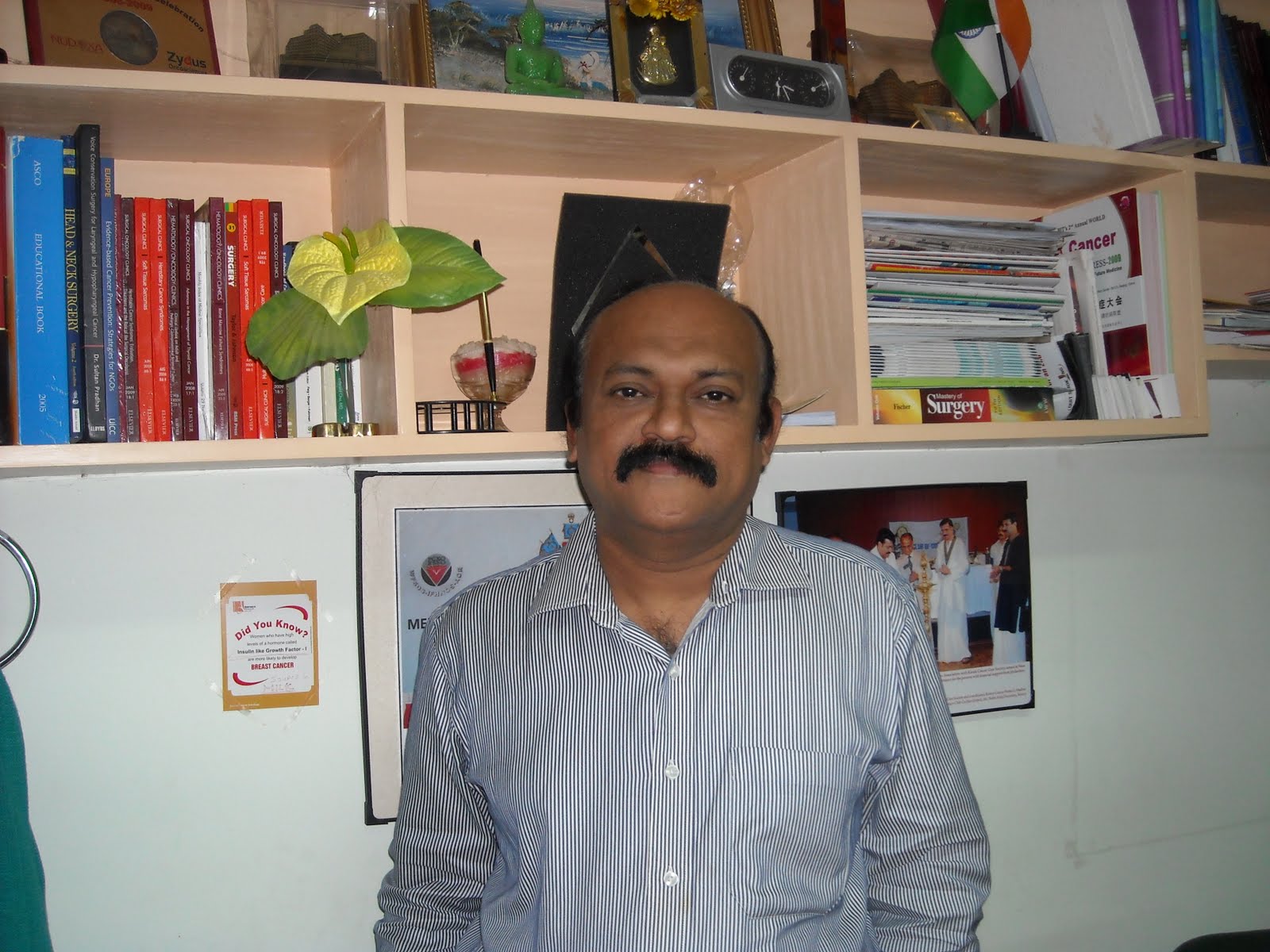
Dealing with a dreaded disease

Dr. Thomas Varughese of Lakeshore hospital deals with cancer victims every day. He talks about the impact of the disease and the precautions that need to be taken

By Shevlin Sebastian

One morning, seven years ago, Rahul George (name changed), 48, was brought to the Lakeshore hospital at Kochi by relatives. Bizarrely, he was carrying a letter from a hospital in Thiruvananthapuram stating that he was suffering from lung cancer and had a week to live. Hence, he was being released.

“Rahul's chest was full of blood,” says Dr. Thomas Varughese, the senior consultant oncologist surgeon. Immediately, a surgery, lasting several hours, was done. One half of the lung was removed. After rest and recuperation Rahul returned to Alleppey where he has just retired as a physiotherapist in a government college. “This is one of my most memorable cases,” says Thomas. “I saved a man from the brink of death.”

Unfortunately, the incidence of cancer is rising alarmingly these days. “Earlier, those who had cancer would be in their fifties or sixties,” says Thomas. “Now, people in their twenties and thirties are afflicted.” For women, the most common is breast, followed by lung cancer. For men, it is lung and head and neck cancer.

One of the major causes is the type of food we are eating. “Milk products are very risky,” he says. “It contains an insulin like growth factor, which is a stimulant of cancer. Milk is a carcinogenic product” (Carcinogenic means anything which can initiate a cancer process within the body).

As for meat, the red content is called haem. “Haem is a carcinogenic,” says Thomas. “When haem is within the meat, it is fine. That is why meat-eating animals don't get cancer. But when meat is cooked, haem gets out. It enters the intestine and causes damage. Cooked meat also contains plenty of nitrous amines. These are also carcinogens, with easy access to the intestine and the bloodstream.”

A meat-heavy diet is one reason why in Europe and the USA, the incidence of colon cancer is very high. Too much oily food is also unhealthy, because it contains saturated fats, which are carcinogenic. Thomas suggests a rich vegetable diet, with a lot of bran. “Bran contains omega 3 fatty acid, which protects against heart attacks and cancer,” he says. “Bran is a soluble fibre. We need fibre in our food, because it acts as a scavenger. It takes away all the waste material from the body.”

Apart from faulty diets, the environment can have an impact. A constant exposure to sunlight can produce skin cancer. In a particular village near Haripad, at least one member of the family has got cancer. “This is because of the radiation from the sand,” says Thomas.

Other reasons for the increased rate of cancer are the widespread habits of drinking alcohol and smoking.

Thomas suggests two precautions: the right diet, and regular exercise. “Exercise burns calories,” says Thomas. “Along with that, protective hormones get activated. These are anabolic hormones, which protect the body.”

During an operating day, Thomas ends up doing all kinds of surgeries: head and neck, throat, breast and abdominal surgeries. In a video that he shows on his computer, he cuts with practiced ease.

“The most difficult part is to inform the patients that they have cancer,” says Thomas. “Whatever way you say it, with a smile, or in a light-hearted manner, the word has the impact of a bombshell.”

The surgeon tries to talk in a calm manner. “I will never get angry with my patients even if they are upset or angry with me,” says Thomas, who is forceful by nature. “The important thing is to inculcate a fighting spirit within them.”

Thanks to recent advances, if a cancer is detected early, there is a strong possibility of a cure. “The PET (Positron Emission Tomography) scan is a wonderful new addition,” says Thomas. A PET scan will show whether the disease is localised or spread all over the body and is far more effective than a CT scan.

Thomas, who has done advanced training in Memorial Sloan Kettering Centre in New York, MD Anderson Cancer Hospital in Texas, John Hopkins University in Baltimore, apart from hospitals in Japan and Australia, has done about 3000 surgeries in the past 24 years. Today, he is optimistic about a cure for cancer. “As the technology improves, especially in diagnosis, radiation and surgery, I am sure there will come a day when people will no longer feel terrified when they are told they have cancer,” he says.

(The New Indian Express, Kochi)


Saturday, July 16, 2011

The discredited ideology of Marxism


Author K.P. Joseph, in his book, 'The Dark Side of Marxism', details the devastating impact of the ideology in Kerala and the rest of the world

By Shevlin Sebastian

“The CPI(M) is a Rs 4000 crore conglomerate which runs television channels and newspapers and other businesses,” says K.P. Joseph, the author of 'The Dark Side of Marxism'. “Just as a corporate entity sells its products through advertising, the party uses ideology for the same reasons.”

And for years their propaganda has been working successfully, because the people continue to vote for them. “The party has cultivated a group of intellectuals who were brought up on Marxism, who keep propagating its benefits,” he says.

But there are no benefits. In fact, the CPI(M) has pushed Kerala's economic development behind by several decades because the party persistently opposed the innovations of science and technology. “When tractors were first introduced it was resisted,” says Joseph. “My friend’s uncle was murdered in Panangad in the 1970s because he dared to use a tractor. Computers were regarded as a threat. They were against the use of auto-rickshaws. Any kind of technology which would empower people, they opposed it.”

If people become prosperous, they will yearn for personal and spiritual development. “As a result, they will not need the party,” says Joseph. “So the leaders wanted the populace to remain poor, so that they can control them.”

And even though Marxism-Leninism has been discredited in Russia, China, and all over the world, the CPI(M) in Kerala is unable to disown it. “If they did that, the foundation on which they have constructed the party and the privileges enjoyed by the leaders will come to an end,” says Joseph.

Nevertheless, Joseph has positive things to say about former Chief Minister V.S. Achuthanandan, of the CPI (M). “He was born in a poor family, a member of the Ezhava caste, and had little education, as compared to former chief minister EMS Namboodiripad, and party general secretary, Prakash Karat,” says Joseph. “And he rose to become Chief Minister. But Achuthanandan's rule had a limited impact, because of his lack of education and vision. But he is a good and honest man. Marxism provided him with an escape from oppression.”

But that is not usually the case, because Marxism goes against human nature. “Marxism denies freedom to the individual,” says Joseph. “The party is in supreme control over society. Sometimes, the party is controlled by one person, like Hitler and Stalin. So, in effect, it is a dictatorship.”

Stalin promised a paradise on earth. But the people were imprisoned in vast numbers in the Gulag Archipelago. “The infrastructure of the Soviet Union was built by slave labour,” says Joseph.

What is stunning to know is how the genocide conducted in the name of the Communist ideology in North Korea, Russia, China, Cambodia, the Communist states of Eastern Europe and in Latin America resulted in the deaths of 125 million people. It was the maximum in China, where 70 million people perished during the reign of Mao Zedong.

The 'Dark Side' is a compilation of articles that Joseph has written over the years. It is divided into two parts. In Part 1, there are 15 essays which analyses the impact of the CPI(M) in Kerala, while in the second half, he looks at the global impact of the Communist ideology.

So what is the ideology that Joseph would suggest, now that Communism is considered derelict? “Those who make wealth should have the responsibility to look after the poorest of the poor,” says Joseph. “But for that to happen, entrepreneurs should be given sufficient freedom to produce wealth. So, I would suggest a mix of capitalism and socialism.”

(The New Indian Express, Kochi)


Friday, July 15, 2011

Bedazzled by the Moon

The Thodupuzha-born Augustine Zacharias is a follower of the Unification Church. Today, he lives in Tokyo, with a Japanese wife, selected by the church's founder Rev. Moon, and has two children

Photo: Augustine Zacharias with his Japanese wife and sons

By Shevlin Sebastian

One day, in 1984, Augustine Zacharias came across an article in the Readers' Digest called, 'A journey through the mind of a cult'. It focused on the Unification Church founded by the Korean-born Rev. Sun Myung Moon. The story detailed the brainwashing that took place, as well as the financial scams of Rev. Moon.

Zacharias, who grew up in Thodupuzha, became curious and began reading the Divine Principles written by Rev. Moon. It seemed to have the answers to the many queries he had. One question which tormented Zacharias was why good people suffered in life.

Rev Moon said, “Suffering occurs because of the actions done by a human being. Sometimes when we think we are doing is the correct action may not be 100 per cent right. For example: killing a man is bad. But if there is a war, and if a soldier kills an enemy, it is considered as a good act. Everyone should have a clear understanding of what is right and wrong.”

Zacharias, born a Catholic, had been disappointed by Christianity. “It does not have the answers especially when you read the Old Testament,” he says. “Why did Cain kill Abel? Why did Noah curse his second son? Why did Tamara have a baby from her father-in-law? There are no clear explanations. In Divine Principles, there are logical answers to all the questions.”

In 1988, Zacharias became a volunteer in the Delhi office of the Unification church. Some years later, he sent his photo to Rev. Moon, who selected a bride for him. She turned out to be a Japanese woman, by the name of Michiko Nozawa. On August 25, 1992, there was a mass marriage of 30,000 couples in the Olympic Stadium at Seoul. “All the pairs were chosen by Rev. Moon,” says Zacharias. Soon, they began their married life in Delhi.

And Zacharias admits the marriage was not easy. “We come from different cultures,” he says. “We have a different mind-set and I had to work hard to make it work.” Interestingly, quite a few couples who took part in the mass marriage broke up within a few years.

Meanwhile, on November 29, 1996, his first child, a son, was born. He was named Bharat. The second son, born two years later, was called Kenta. In 1998, they went to Tokyo and settled down there. Zacharias started a business, selling Indian handicrafts and silks. Later, he set up an Indian restaurant, and, finally, he began exporting excavators and other machineries to India and other countries.

During this time, Zacharias continued to be a volunteer for the Unification church. “I would work on holidays and weekends, and whenever there were any public events,” he says. There are a million adherents in Japan. Worldwide, there are 43 million followers.
Most of the disciples are from Korea, Japan, Taiwan, Thailand, Malaysia and America. ““People come and go, sometimes, they return,” says Zacharias. “My children are members. Bharat is a student leader in the church.”

Unfortunately, Zacharia’s actions have caused repercussions at home. “I was ex-communicated from the Catholic church,” says Zacharias, while on a recent visit to Kochi. “The priest said my wife should become a Catholic. I told him I could not force her, since she is a Buddhist. Then he said I could not stay in the church.”

Meanwhile, his mother was deeply upset. She begged him to return to the Catholic church insisting that he belonged to a cult, but he refused. His four brothers and a sister and their families have constantly faced the ire of society. But for Zacharias, there was no turning back.

“Rev. Moon is the saviour of mankind,” he says. “I believe he is the second coming of Christ. If I don't follow him, I will be making a big mistake. During Jesus's life, people never regarded him as a saviour. So is the case with Moon. I don't want to make the same error. So, even though I face difficulties in my family and society, I will always remain faithful to Rev. Moon.”


Monday, July 11, 2011

An outsider's perspective

A British teacher learns about teaching methods and the abilities of students at Rajagiri Public school, and compares them with his students

By Shevlin Sebastian

At a presentation by a group of Class nine students of Rajagiri Public school, Kochi, Eugene Collins, a teacher of Stanmore College in London was taken aback by how articulate the students were. “It was remarkable,” he says. The students spoke about the recent Arab uprising, and the situation in Burma. “I was impressed by the level of research that they had undertaken,” he says. “The presentation style was very effective.”

Collins wants his students in London to have the same interest in international issues. “They find it difficult to think about life outside of London,” he says. “One of my aims is to expand their understanding of the world.”

Collins is in Kochi as part of the Global School Partnerships programme, funded by the UK Aid from the Department for International Development. The project enables teachers and students in the United Kingdom to learn about global issues, in partnership with schools in Africa, Latin America, the Caribbean, and Asia.

In India, the Rajagiri Public School has been selected. But it is an exploratory trip for Collins, who is working closely with English teachers, Ruby Antony and Parimal Paul, on how to set up a viable programme.

“The initial aim is to develop an international ethos among the students in London and Kochi,” says Ruby. “We felt that human rights can be a common subject.”

The students in London will be working with refugees who come to Britain. They include people from Iraq, Afghanistan, and Somalia. “The youngsters will befriend a refugee who is of a similar age and help them to access educational facilities and social welfare,” says Collins.

In Kochi, Ruby will enable her students to focus on gender issues, poverty, and the caste system. “Later, a student exchange programme will take place,” she says. “The aim is to break down the misconceptions among the Indians and the British.”

Some of the misconceptions are on expected lines. “My students, a mix of Indians, West Indians and whites, know about Bollywood,” says Collins. “They have seen the film, 'Slumdog Millionaire'. Not surprisingly, their impression of India is that it is a poor and backward country. I want to make them understand that India is a growing economic power and progressing very rapidly.”

Meanwhile, students in Rajagiri think that London is a big and developed city with shiny buildings. “The reality is that there is terrible poverty in London,” says Collins. “Our city is not just about the royal family or the Buckingham Palace. The economy is in bad shape, so life is tough. Recently, the teachers went on strike nation-wide because of changes in the pension shame. So, there are misconceptions on both sides.”

Meanwhile, as Collins wandered around the Rajagiri campus, interacting with teachers and students, he noticed that the teaching styles were different. “In India the relationship between the student and the teacher is very formal,” he says. “The teacher talks and the students listen. In my school, it is much more interactive. The students learn, by doing, rather than memorising. The students here treat their teachers with a lot of deference, and it is very lovely to see this. In London, students call the teacher by the first name. They don't wear uniforms. But, I guess, each country has its own way.”

(The New Indian Express, Kerala)